Challenge
Shark's teeth and the octagonal STOP sign (B7) often appear at the same kind of junctions, so learners glue 'triangles' and 'stop' together. The CBR exam designer tests exactly that: shark's teeth say 'pay attention, give way' — only B7 says 'come to a full stop'.
Read this section on its own page: Challenge: Shark's teeth: give way, not a stop requirement
The model
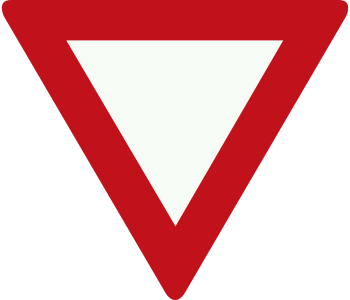
Shark's teeth mean: give way to drivers on the crossing road — not a stop requirement. They are themselves a binding traffic sign, even without a sign next to them. Sign B6 means the same thing; sign B7 adds an actual stop requirement.
Read this section on its own page: The model: Shark's teeth: give way, not a stop requirement
Core
'Giving way' means: slow down, look carefully, and only stop if that is genuinely needed to let a crossing driver go first. If the road is clear, you do not need to come to a standstill. A full stop is only mandatory where the law explicitly requires it — at sign B7: there you always stop at the stop line, even if the road looks empty. B6 and shark's teeth share the same, milder meaning; B7 is the stricter variant with an extra stop duty on top. Shark's teeth do not need a sign next to them to apply: the marking itself is a traffic sign you are required to follow. And where there are no shark's teeth and no sign, you fall back on the right-hand rule: priority to drivers from the right.
Read this section on its own page: Core: Shark's teeth: give way, not a stop requirement
Why it matters
Stopping unnecessarily at shark's teeth on an empty road near Hilversum surprises the driver behind you and can cause a rear-end collision; driving through without looking at B7 because 'it's just like shark's teeth anyway' can send you straight into crossing traffic. The difference between 'pay attention' and 'come to a standstill' is exactly what keeps these two signs apart.
Read this section on its own page: Why it matters: Shark's teeth: give way, not a stop requirement
Source: RVV 1990 art. 15 · RVV 1990 art. 62 · RVV 1990 art. 79 · RVV 1990 art. 80 · checked 2026-10-22
Frequently asked questions
‘Shark's teeth require a full stop, just like sign B7’ – is that true?
No. Shark's teeth mean: give way, not a stop requirement. A full stop is only mandatory where sign B7 explicitly requires it, at the stop line
‘Shark's teeth only apply if a sign B6 also stands next to them; without a sign the marking is not binding’ – is that true?
No. Shark's teeth are themselves a traffic sign and are binding, even without a sign next to them. The legal duty is directly in the marking
‘Sign B6 and sign B7 mean exactly the same thing: both 'give way'’ – is that true?
No. B6 means 'give way', just like shark's teeth. B7 adds an explicit stop requirement on top: 'stop; give way'. B7 is therefore stricter than B6
‘If a junction has neither shark's teeth nor a sign, no right-of-way rule applies at all’ – is that true?
No. If shark's teeth and signs are absent, the main rule automatically applies: priority to drivers from the right. No sign never means 'no rule'
‘At a junction without shark's teeth or priority signs, the driver on the wider or busier road has priority’ – is that true?
No. Without shark's teeth or priority signs the main rule applies at junctions: priority to drivers from the right. The width or busyness of the road does not regulate priority