Theory Mastery

Direction of travel and overtaking bans: D-signs and F-signs

What the exam asks here: Students often treat F1 and F3 as the same 'overtaking ban', and assume with D4-D7 that every code has a fixed direction, as with A- and B-signs.

14 minutes · 7 sections · 12 questions

The trap

Many learners think: Sign F1 bans everyone from overtaking: motor vehicles may not pass cyclists or moped riders either.

The rule is: F1 bans motor vehicles from overtaking EACH OTHER; mopeds are not motor vehicles, so passing a moped rider does not fall under it

Challenge

Students often treat F1 and F3 as the same 'overtaking ban', and assume with D4-D7 that every code has a fixed direction, as with A- and B-signs. Both assumptions are exactly what the CBR exam designer builds a trick question on: it's not about the code alone, but about WHO the sign addresses and WHAT is literally shown on it.

Read this section on its own page: Challenge: Direction of travel and overtaking bans: D-signs and F-signs

The model

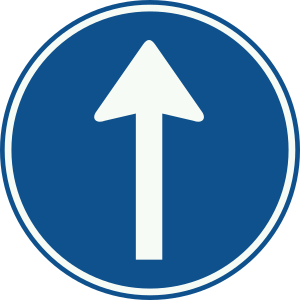
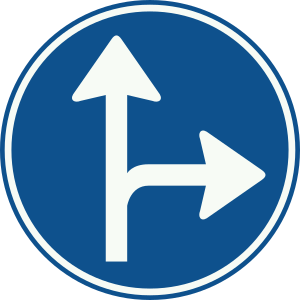
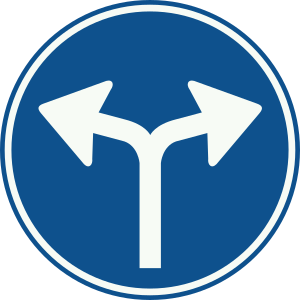
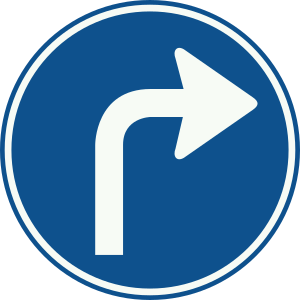
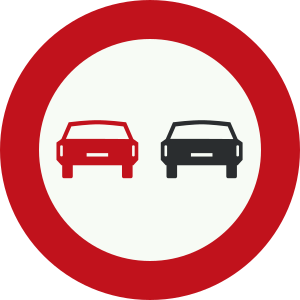
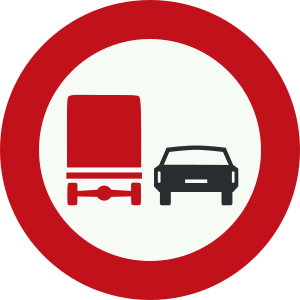
D4/D5: one arrow, fixed direction — you follow exactly what the sign shows. D6/D7: multiple arrows, free choice — you follow one of the shown directions. F1 bans motor vehicles from overtaking each other; F3 specifically bans trucks from overtaking motor vehicles (Book p.241-244) — overtaking a cyclist or moped rider falls under neither F1 nor F3.

Read this section on its own page: The model: Direction of travel and overtaking bans: D-signs and F-signs

Core

The D category (Book p.241) regulates mandatory directions of travel. D1 belongs to a roundabout: you follow the indicated direction around the central island. D2 requires drivers to pass the sign on the side the arrow shows — for example at a speed bump or obstacle. D4 and D5 show one arrow: that arrow IS the duty, literally the direction shown on the sign, not a fixed meaning tied to the code itself. D6 and D7 show two or more arrows and offer a choice: you must follow one of the shown directions, but which one doesn't matter — both are equally valid. The F category regulates specific overtaking bans, and the precision lies in the target group. F1 bans motor vehicles from overtaking EACH OTHER — two cars, or a car and a truck. Because mopeds are legally not motor vehicles, a car may simply pass a moped rider under an F1 sign; that is not 'overtaking a motor vehicle'. F3 is even more specific: it only bans TRUCKS (motor vehicles with a permitted maximum mass over 3500 kg) from overtaking motor vehicles. A car may therefore simply overtake another car under an F3 sign; the sign is not addressed to it.

Read this section on its own page: Core: Direction of travel and overtaking bans: D-signs and F-signs

Why it matters

Whoever reads F3 as a general overtaking ban unnecessarily slows down behind a slow truck in a spot where that's not required at all, creating a tailback themselves. Whoever reads D6/D7 as a primary direction with a fallback unnecessarily picks the 'wrong' direction as if it were incorrect — while both shown directions are legal.

Read this section on its own page: Why it matters: Direction of travel and overtaking bans: D-signs and F-signs

Active recall

Near Nijmegen you are driving a car behind a slow truck, right after an F3 sign. May you overtake the truck?

Read this section on its own page: Active recall: Direction of travel and overtaking bans: D-signs and F-signs

Teach back

Explain: what is the difference between sign D4/D5 and D6/D7, and why may a car overtake another car under an F3 sign?

Read this section on its own page: Teach back: Direction of travel and overtaking bans: D-signs and F-signs

Memory hook

One arrow = must follow it (D4/D5). More arrows = choose one (D6/D7). F1 = motor vehicles among themselves. F3 = trucks only.

Read this section on its own page: Memory hook: Direction of travel and overtaking bans: D-signs and F-signs

Source: RVV 1990 art. 1 · checked 2026-10-22

The picture

D-signs: fixed direction vs. choice; F-signs: who may not overtake whomD4/D5D6/D7Number of arrowsone arrowtwo or more arrowsDuty (Book p.241)follow exactly the indicated directionchoose one of the indicated directions, equally validF1 vs. F3 target group (Book p.242)F1: all motor vehicles, among each otherF3: only trucks, against motor vehicles
What to look at: D4=fixed direction via arrow. D6=choose one of two arrows. F1=motor vehicles may not overtake each other. F3=only trucks may not overtake motor vehicles.

Signs and law

Test yourself

On the N279 near Helmond a truck approaches a cyclist riding on the carriageway, right after an F3 sign. May the truck overtake the cyclist?

Show the answer

D4/D5: one arrow, fixed direction — you follow exactly what the sign shows. D6/D7: multiple arrows, free choice — you follow one of the shown directions. F1 bans motor vehicles from overtaking each other; F3 specifically bans trucks from overtaking motor vehicles (Book p.241-244) — overtaking a cyclist or moped rider falls under neither F1 nor F3.

Exam questions on this topic

On a narrow road outside the built-up area near Tilburg there is an F1 sign. There is no cycle path and a moped rider is riding ahead of you on the carriageway. The road has a clear view and nobody is coming the other way. You want to overtake the moped rider. Is that allowed?

  1. Yes, the ban only applies when you overtake a motor vehicle
  2. No, under this sign you may not overtake moped riders or cyclists either
  3. No, a moped has an engine and so falls under the ban
Show the answer

Correct answer: Yes, the ban only applies when you overtake a motor vehicle

False — you count the moped as a motor vehicle because it has an engine. In the traffic rules a moped is not a motor vehicle, so under sign F1 you may overtake a moped rider; a motorcycle or car you may not.

Why learners get this wrong: Sign F1 bans everyone from overtaking: motor vehicles may not pass cyclists or moped riders either.

Open this question

On the A67 near Venlo you pass an F3 sign. Behind a slow truck you want to overtake — you yourself are driving a car. Is that allowed?

  1. No, F3 is a general ban on overtaking motor vehicles, passenger cars included
  2. Yes, F3 only bans trucks from overtaking motor vehicles, not cars
Show the answer

Correct answer: Yes, F3 only bans trucks from overtaking motor vehicles, not cars

Why learners get this wrong: Sign F3 bans all drivers — including car drivers — from overtaking motor vehicles.

Open this question

At a junction in Enschede there is a round blue D4 sign for your lane with a white arrow pointing left. Your passenger says: 'A D4 sign always means turn right, so you have to turn right here.' Is that true?

  1. True
  2. False
Show the answer

Correct answer: False

False — you read the sign code instead of the arrow. With a round blue sign with one arrow you follow the direction the arrow on the sign shows; here that is left.

Why learners get this wrong: Sign D4 always means 'mandatory turn right'; the arrow shown is decoration, the code itself fixes the direction.

Open this question

At a junction in Hengelo there is a round blue D6 sign for your lane with two white arrows: one straight ahead and one to the right. You want to go straight on to the centre. What applies to you here?

  1. Left as well; a blue sign with arrows is only advice
  2. Right; straight on is only a fallback if turning right is not possible
  3. Straight on or right; you choose one of the two arrows yourself
Show the answer

Correct answer: Straight on or right; you choose one of the two arrows yourself

False — you read two equal arrows as a main and a fallback direction. With a sign showing two arrows you follow one of the directions shown, as you choose; so going straight on is simply allowed here.

Why learners get this wrong: A round blue sign with arrows is advice; you may also choose a direction that is not on the sign.

Open this question

You are driving a van fitted out only for goods and pass sign F3 near Zwolle. Above which permitted maximum mass (in kg) does this overtaking ban also apply to your van?

Show the answer

Correct answer: 3500 kg

Correct: 3500.0 kg.

Open this question

At a roundabout in Almelo stands sign D1. What does this sign require you to do?

  1. Follow the direction of travel shown on the sign around the central island
  2. Yield to drivers already on the roundabout, without a direction requirement
Show the answer

Correct answer: Follow the direction of travel shown on the sign around the central island

Why learners get this wrong: Sign D1 at a roundabout regulates priority: you give way to traffic on the roundabout; it prescribes no direction of travel.

Open this question

About Direction of travel and overtaking bans: D-signs and F-signs: which statement is WRONG?

  1. The duty is following ONE OF the directions shown on the sign — both displayed arrows are equally valid, there is no primary and fallback direction.
  2. Sign D4 always means 'mandatory turn right'; the arrow shown is decoration, the code itself fixes the direction.
  3. F3 specifically bans TRUCKS from overtaking motor vehicles, not cars or other drivers.
  4. F1 bans motor vehicles from overtaking EACH OTHER; mopeds are not motor vehicles, so passing a moped rider does not fall under it.
Show the answer

Correct answer: Sign D4 always means 'mandatory turn right'; the arrow shown is decoration, the code itself fixes the direction.

The duty is the direction shown on the sign — the arrow determines the direction, not the code itself; the same code D4 can point a different way with a different arrow

Why learners get this wrong: Sign D6 (with two arrows, straight ahead and right) requires you to specifically drive straight ahead; turning right is merely a fallback option.

Open this question

About Direction of travel and overtaking bans: D-signs and F-signs: which statement is WRONG?

  1. F1 bans motor vehicles from overtaking EACH OTHER; mopeds are not motor vehicles, so passing a moped rider does not fall under it.
  2. Sign D6 (with two arrows, straight ahead and right) requires you to specifically drive straight ahead; turning right is merely a fallback option.
  3. The duty is the direction shown on the sign — the arrow determines the direction, not the code itself; the same code D4 can point a different way with a different arrow.
  4. F3 specifically bans TRUCKS from overtaking motor vehicles, not cars or other drivers.
Show the answer

Correct answer: Sign D6 (with two arrows, straight ahead and right) requires you to specifically drive straight ahead; turning right is merely a fallback option.

The duty is following ONE OF the directions shown on the sign — both displayed arrows are equally valid, there is no primary and fallback direction

Why learners get this wrong: Sign F1 bans everyone from overtaking: motor vehicles may not pass cyclists or moped riders either.

Open this question

The duty is following ONE OF the directions shown on the sign — both displayed arrows are equally valid, there is no primary and fallback direction.

  1. False
  2. True
Show the answer

Correct answer: True

The duty is following ONE OF the directions shown on the sign — both displayed arrows are equally valid, there is no primary and fallback direction

Why learners get this wrong: Sign D6 (with two arrows, straight ahead and right) requires you to specifically drive straight ahead; turning right is merely a fallback option.

Open this question

About Direction of travel and overtaking bans: D-signs and F-signs: which statement is WRONG?

  1. F3 specifically bans TRUCKS from overtaking motor vehicles, not cars or other drivers.
  2. Sign F1 bans everyone from overtaking: motor vehicles may not pass cyclists or moped riders either.
  3. The duty is following ONE OF the directions shown on the sign — both displayed arrows are equally valid, there is no primary and fallback direction.
  4. The duty is the direction shown on the sign — the arrow determines the direction, not the code itself; the same code D4 can point a different way with a different arrow.
Show the answer

Correct answer: Sign F1 bans everyone from overtaking: motor vehicles may not pass cyclists or moped riders either.

F1 bans motor vehicles from overtaking EACH OTHER; mopeds are not motor vehicles, so passing a moped rider does not fall under it

Why learners get this wrong: Sign F3 bans all drivers — including car drivers — from overtaking motor vehicles.

Open this question

All practice questions of this topic

Frequently asked questions

‘Sign F1 bans everyone from overtaking: motor vehicles may not pass cyclists or moped riders either’ – is that true?

No. F1 bans motor vehicles from overtaking EACH OTHER; mopeds are not motor vehicles, so passing a moped rider does not fall under it

‘Sign F3 bans all drivers — including car drivers — from overtaking motor vehicles’ – is that true?

No. F3 specifically bans TRUCKS from overtaking motor vehicles, not cars or other drivers

‘Sign D4 always means 'mandatory turn right'; the arrow shown is decoration, the code itself fixes the direction’ – is that true?

No. The duty is the direction shown on the sign — the arrow determines the direction, not the code itself; the same code D4 can point a different way with a different arrow

‘Sign D6 (with two arrows, straight ahead and right) requires you to specifically drive straight ahead; turning right is merely a fallback option’ – is that true?

No. The duty is following ONE OF the directions shown on the sign — both displayed arrows are equally valid, there is no primary and fallback direction

‘A moped has an engine and is therefore a motor vehicle; under sign F1 a car may therefore not overtake a moped rider’ – is that true?

No. In the traffic rules a moped is not a motor vehicle; sign F1 only forbids motor vehicles to overtake each other, so under it you may overtake a moped rider, but not a motorcycle
Related topics

Open in the app