Challenge
Students often learn C17 through C21 as one block of 'number-on-sign signs' and expect C22 to continue that pattern with yet another dimension. The CBR exam designer counts precisely on that assumption: C22 is the exception in the sequence, and whoever blindly extends the pattern also misses why C6 contains a detail that flips its meaning.
Read this section on its own page: Challenge: Closure signs C: who, what and which number is barred
The model
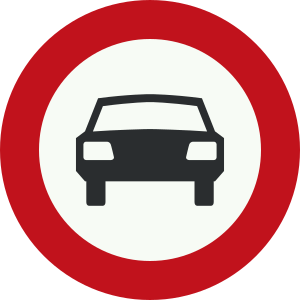
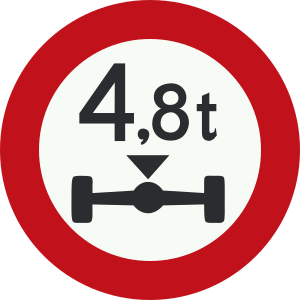
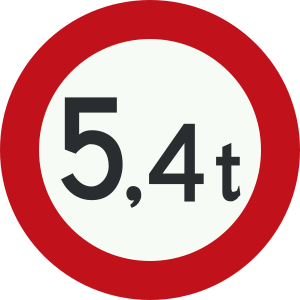
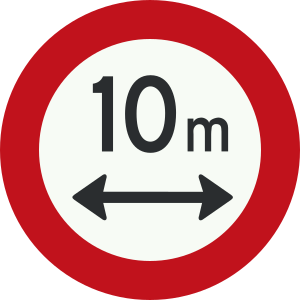
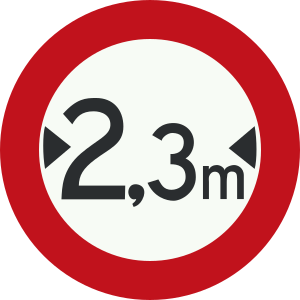
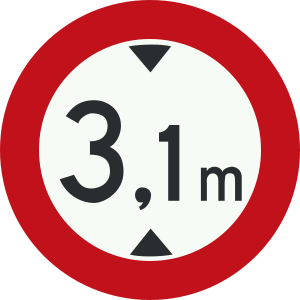
C17 = length, C18 = width, C19 = height, C21 = mass (total mass or sum of the axle loads, including load) — all with a number on the sign. C22 breaks that pattern: no number, closed to certain dangerous goods (Book p.239-240). And C6 only closes motor vehicles WITH MORE THAN TWO WHEELS — so a motorcycle may still pass.
Read this section on its own page: The model: Closure signs C: who, what and which number is barred
Core
The C category (Book p.239-240) closes a road to a specific kind of traffic, and the C-codes fall into two families. The first family regulates dimensions and mass with an explicit number on the sign: C17 (length), C18 (width), C19 (height) and C21 (total mass or the sum of the axle loads). All of these thresholds count the load — a truck that stays under the threshold empty but goes over it once loaded still falls under the ban. C22 belongs to a second family: no number, but a category. The sign excludes vehicles carrying certain dangerous goods, regardless of how large or heavy the vehicle is — a small van with the wrong load is caught just as much as a large tanker. Within the 'who may not pass' signs there is another precision trap: C6 does not exclude 'all motor vehicles', but specifically motor vehicles with more than two wheels. A motorcycle (two wheels) may therefore simply drive through a C6 sign, while an ordinary car may not. Cyclists, under a closure sign, are by default also caught by the ban (they are, after all, vehicles) — only an under-sign with the word 'uitgezonderd' plus the cycle symbol explicitly exempts them.
Read this section on its own page: Core: Closure signs C: who, what and which number is barred
Why it matters
Whoever reads C22 as 'just another dimension sign' misses exactly the sign that keeps a dangerous load out of a residential area or tunnel — the reason it exists. Whoever reads C6 too broadly wrongly makes a motorcyclist wait at a sign that only excludes wider motor vehicles, or wrongly assumes their own car is exempt.
Read this section on its own page: Why it matters: Closure signs C: who, what and which number is barred
Source: RVV 1990 art. 62 · checked 2026-10-22
Frequently asked questions
‘Sign C22 closes the road to vehicles that, including load, are longer than the indicated figure — just like C17’ – is that true?
No. C17 = length; C22 = closed to vehicles carrying certain dangerous goods, not a dimension
‘Sign C6 closes the road to all motor vehicles, so also to an ordinary car’ – is that true?
No. C6 = closed to motor vehicles WITH MORE THAN TWO WHEELS; this excludes a motorcycle (two wheels) from the ban, but an ordinary car falls under it
‘A closure never applies to cyclists; they may always continue regardless of which sign is present’ – is that true?
No. Cyclists are only exempt if an under-sign with 'uitgezonderd' plus the cycle symbol explicitly says so; without that under-sign the ban applies to them too
‘Sign C21 looks at the permitted maximum mass on the registration certificate, not at what is actually in the car that day’ – is that true?
No. The sign looks at the total mass or the sum of the axle loads — the actual, measured mass — not the permitted maximum mass on paper
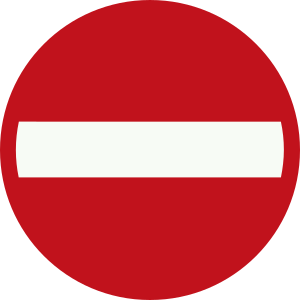
‘Sign C2 (red disc, white bar) regulates a narrow passage: you may enter once you have given way to oncoming traffic’ – is that true?
No. C2 = one-way road, CLOSED in this direction to vehicles, riders and drovers; it is a ban on entering — the narrow-passage rule is F5 (red arrow)