You drive your car along a through road into the built-up area of Zwolle. After the place-name sign you see no further speed sign. What is the maximum speed you may drive here (in km/h)?
Show the answer
Correct answer: 50 km/u
Correct: 50.0 km/u.
What the exam asks here: Most students know the round red-bordered sign well, but confuse the blue advisory sign and the digital matrix sign with each other — they often call the blue sign 'A3'.
Many learners think: The blue rectangular advisory sign with a number on it is called sign A3.
The rule is: A3 = maximum speed on an electronic signalling sign (matrix sign); A4 = advisory speed (blue rectangular sign)
Most students know the round red-bordered sign well, but confuse the blue advisory sign and the digital matrix sign with each other — they often call the blue sign 'A3'. The CBR exam designer knows this, and builds exactly on it: whoever doesn't know the shape code flawlessly also misses why a matrix sign IS binding and a blue sign is not.
A1 (round, red border) = maximum speed, binding. A2 is the same sign with a grey stripe through it: end of maximum. A3 is the matrix sign — an electronic signalling sign above the lane — and counts fully as a traffic sign (Book p.238, p.49-50). A4 is the blue rectangular advisory sign: not mandatory, no fine for exceeding it. A5 is end of advisory. If a fixed sign and a matrix sign both show a speed at once, the lowest applies.
The A-sign category (Book p.238) regulates speed with five codes. A1 is the classic round maximum speed; whoever drives faster violates the law (mandatory compliance with an order/prohibition sign). A2 closes that zone. A3 is not, as often assumed, the advisory sign — A3 is the electronic signalling sign (matrix sign) above the lane, which thanks to the law has exactly the same binding status as a fixed sign. On some stretches (for example during congestion or roadworks) the matrix sign shows a lower number than the fixed sign next to it; the law settles that: the lower of the two numbers applies, regardless of which sign looks more 'permanent'. A4 is the blue rectangular advisory sign: a recommended speed for safe passage of the road section (for example in a sharp bend), but not mandatory — ignoring it does not result in a fine, though it is unwise if the bend genuinely calls for that number. A5 closes that advisory. If the word 'zone' appears above an A-sign, the sign applies not only at that one spot but throughout the ENTIRE indicated area, until the matching end-of-zone sign appears — even past every side street without a new sign.
Whoever mistakes the blue advisory sign for binding brakes unnecessarily hard in the middle of a motorway, creating exactly the danger they meant to avoid; whoever ignores a matrix sign because it's 'just a screen' drives through a reduced limit during congestion or roadworks — precisely the situations where a lower speed is the difference between stopping in time and a rear-end collision.
Near Breda the fixed round sign shows '100' and at the same time the matrix sign above it shows '80'. You are driving 90. What is true?
Explain: which sign is A3, which sign is A4, and what happens when a fixed sign and a matrix sign show a different speed at the same time?
Round = must, blue rectangle = may. Matrix sign counts as a round sign. Two numbers at once? The lowest wins.
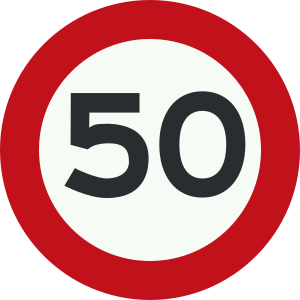
A1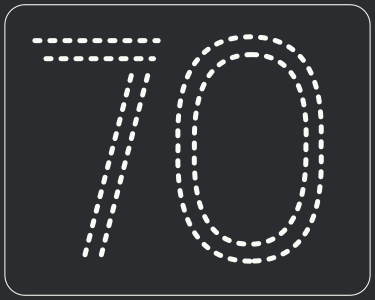
A3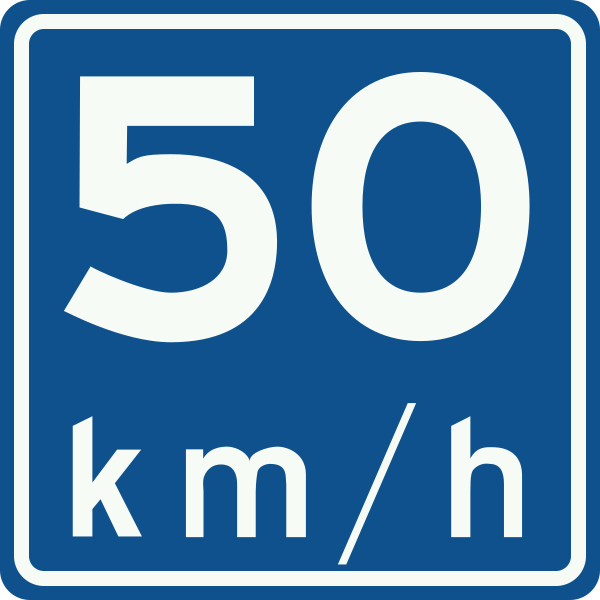
A4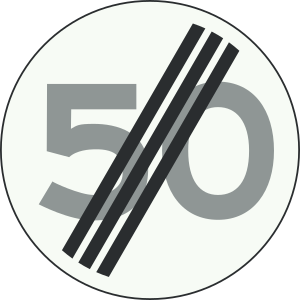
A2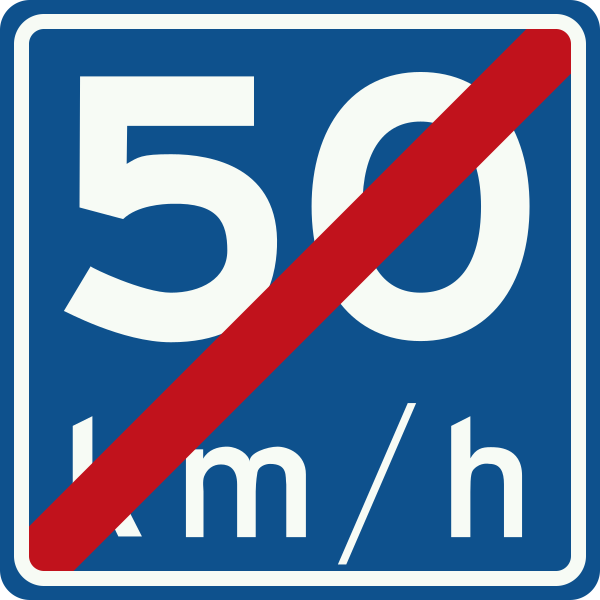
A5On the A2 near Utrecht you see a black matrix sign above the lane lighting up with a white '80', while the fixed round sign along the crash barrier still shows '100'. Which speed applies to you now?
A1 (round, red border) = maximum speed, binding. A2 is the same sign with a grey stripe through it: end of maximum. A3 is the matrix sign — an electronic signalling sign above the lane — and counts fully as a traffic sign (Book p.238, p.49-50). A4 is the blue rectangular advisory sign: not mandatory, no fine for exceeding it. A5 is end of advisory. If a fixed sign and a matrix sign both show a speed at once, the lowest applies.
Correct answer: 50 km/u
Correct: 50.0 km/u.
Correct answer: Sign A4, advisory speed — you may ignore it without a fine
Why learners get this wrong: A blue rectangular sign with a white number is sign A1: a maximum speed you are obliged to obey.
Correct answer: You are driving too fast: of the two numbers the lowest applies, 80
False — you let the fixed sign win because it is permanent. When a fixed sign and a matrix sign show a speed limit at the same time, the lowest applies, so here 80.
Why learners get this wrong: A matrix sign above the lane is only an indication; the fixed round signs along the road are the only real, binding traffic signs.
Correct answer: False
False — you read a zone sign as if it only applies to one street. A sign with 'zone' above it applies in the whole area behind it, also in side streets without their own sign, until you pass an 'end of zone' sign. (VekaBest theorieboek, Hoofdstuk 3 §3.1 p.49-50 + Hoofdstuk 14 'A Snelheid' p.238)
Why learners get this wrong: A 30-zone sign only applies to the street it stands on; every side street needs its own zone sign again.
Correct answer: A2, end of maximum speed
Why learners get this wrong: A round sign with a grey bar through the number is sign A5: end of advisory speed.
Correct answer: The black background is the 'start sign': it indicates that a new maximum speed begins here
Why learners get this wrong: The background colour of a matrix sign has no meaning of its own; only the number counts.
Correct answer: A3 = maximum speed on an electronic signalling sign (matrix sign); A4 = advisory speed (blue rectangular sign).
A3 = maximum speed on an electronic signalling sign (matrix sign); A4 = advisory speed (blue rectangular sign)
Why learners get this wrong: If a fixed sign shows '100' and the matrix sign above it shows '80', you may still drive 100 as long as the fixed sign has not been removed.
Correct answer: True
A3 = maximum speed on an electronic signalling sign (matrix sign); A4 = advisory speed (blue rectangular sign)
Why learners get this wrong: The blue rectangular advisory sign with a number on it is called sign A3.
Correct answer: You are breaking the rule: the lower of the two, 80, applies
A matrix sign is a full traffic sign and the lowest speed applies when both are shown
Why learners get this wrong: A matrix sign above the lane is only an indication; the fixed round signs along the road are the only real, binding traffic signs.
Correct answer: A sign with 'zone' above it applies to the ENTIRE indicated area, until the end-of-zone sign — not only to the street the sign stands on.
A sign with 'zone' above it applies to the ENTIRE indicated area, until the end-of-zone sign — not only to the street the sign stands on
Why learners get this wrong: If a fixed sign shows '100' and the matrix sign above it shows '80', you may still drive 100 as long as the fixed sign has not been removed.
No. A3 = maximum speed on an electronic signalling sign (matrix sign); A4 = advisory speed (blue rectangular sign)
No. Traffic signs may be displayed on an electronic signalling sign; when a fixed sign and a matrix sign both show a speed at once, the lowest one applies
No. The LOWEST indicated maximum speed applies, not the more permanent one. With sign 100 + matrix 80, 80 applies
No. A sign with 'zone' above it applies to the ENTIRE indicated area, until the end-of-zone sign — not only to the street the sign stands on
No. A1 is round with a red border, not blue rectangular. Blue rectangular = A4, advisory.