Challenge
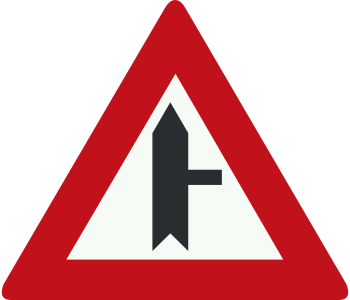
Students usually remember B6 and B7 correctly — red and triangular or octagonal stands out. But they often confuse B4 and B5: the intuition 'B4 comes first so it must be right, since right has priority' is wrong, and it's exactly what the CBR exam designer counts on.
Read this section on its own page: Challenge: Priority signs B: priority road, look-or-stop, and which side
The model
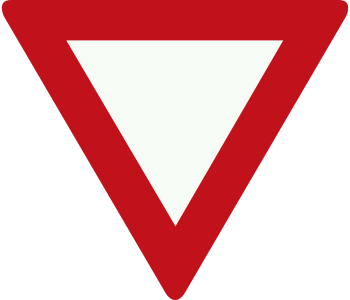
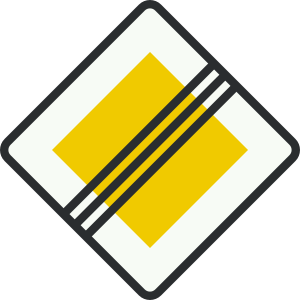
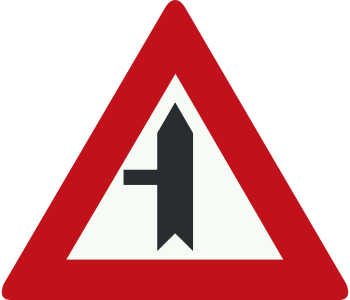
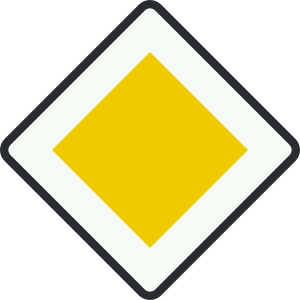
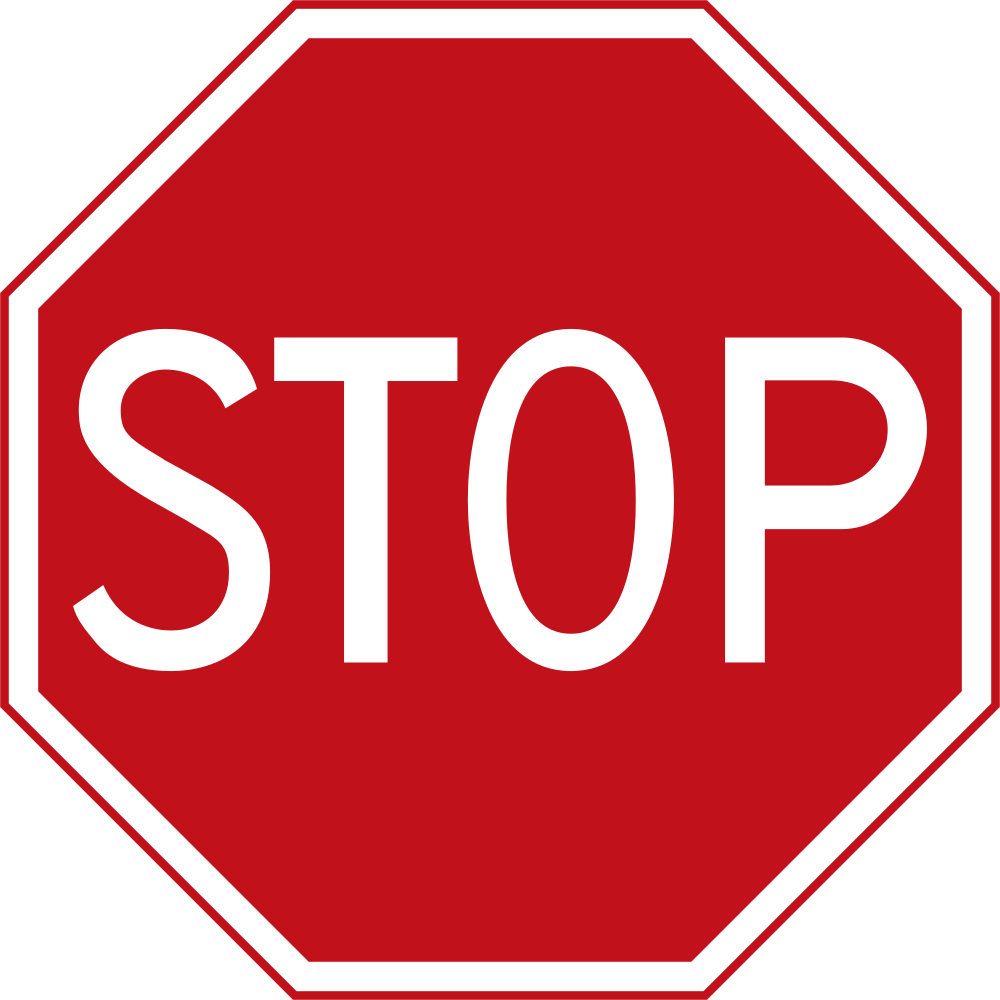
B1 (yellow diamond) = priority road, valid until sign B2 (end of priority road). B6 (red triangle) = yield right of way — look and assess, no stop requirement. B7 (red octagon) = STOP + yield right of way — coming to a full stop is mandatory here. And the direction: B4 = side road on the LEFT, B5 = side road on the RIGHT (Book p.238) — not the other way round.
Read this section on its own page: The model: Priority signs B: priority road, look-or-stop, and which side
Core
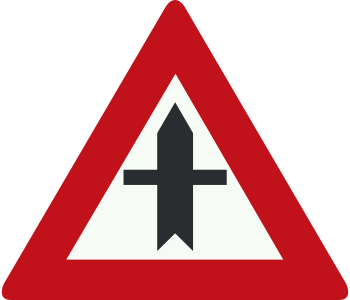
The B-sign category (Book p.238) regulates who has priority at a crossroads, and how strictly. B1 marks a priority road: at every crossing along that road you have priority, until sign B2 lifts that status — the status is tied to the sign, not to a municipal boundary or a duration. B3 simply announces a priority crossroads without further direction; B4 and B5 do so more specifically, with an arrow symbol showing from which side the side road joins: B4 from the left, B5 from the right (Book p.238 confirms this word for word). B6 and B7 look alike — both red, both 'yield to drivers on the crossing road' — but differ sharply in requirement. B6, the red inverted triangle, asks you to look, assess, and proceed as soon as it's safe; there is no stop line. B7, the red octagon (the only octagonal sign in the whole system), adds a hard stop requirement to that: you must come to a complete stop before the stop line, even if the road looks empty. Shark's teeth road markings are not decoration next to a B6 sign: they independently carry exactly the same legal meaning — yield to drivers on the crossing road — even without a separate sign next to them.
Read this section on its own page: Core: Priority signs B: priority road, look-or-stop, and which side
Why it matters
Whoever swaps B4 and B5 looks the wrong way at the critical moment — exactly the second a car from the other side can merge in. Whoever confuses B6 with B7 and therefore does not come to a full stop drives through a crossing where the law demands a standstill, with all the consequences that carries in a collision.
Read this section on its own page: Why it matters: Priority signs B: priority road, look-or-stop, and which side
Source: RVV 1990 art. 15 · checked 2026-10-22
Frequently asked questions
‘Sign B4 (Priority crossroads) warns of a side road coming from the RIGHT; B5 warns of a side road from the LEFT’ – is that true?
No. B4 = side road on the LEFT, B5 = side road on the RIGHT
‘On a B1 priority road you always have priority, at every crossing until the end of the municipality’ – is that true?
No. B1 applies until sign B2 (end of priority road) appears, not until a municipal boundary or indefinitely
‘Sign B6 (red inverted triangle) requires you, just like B7, to come to a full stop before yielding’ – is that true?
No. B6 = yield right of way (no stop requirement), B7 = stop + yield right of way
‘Shark's teeth road markings are just a visual reminder; the real priority rule comes only from the sign next to them’ – is that true?
No. Shark's teeth independently carry the same meaning as B6: yield to drivers on the crossing road
‘After sign B2 (end of priority road) you are on a side road and must give way to traffic from both the left and the right’ – is that true?
No. B2 only ends the priority road; without other signs the main rule applies: traffic from the right goes first, traffic from the left does not.