Challenge
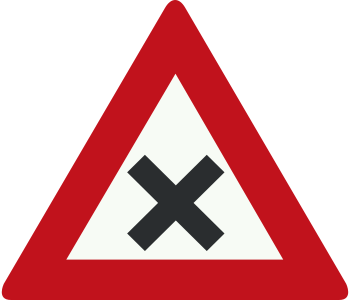
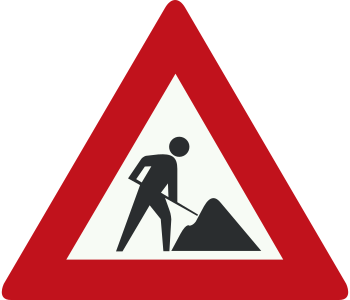
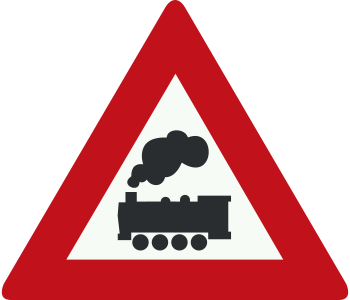
Most students recognise the symbol on a J-sign effortlessly (a train, a shovel, a child), but remember the exact code wrong — often systematically shifted by one position, such as J10 instead of J8 for a crossroads. The CBR exam designer tests exactly that code-symbol pairing, not just the symbol itself.
Read this section on its own page: Challenge: Warning signs J: triangle, not a command
The model
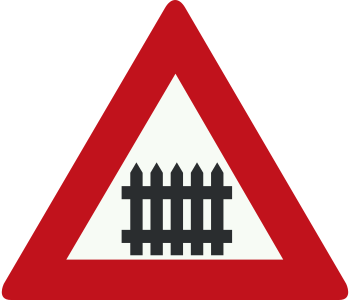
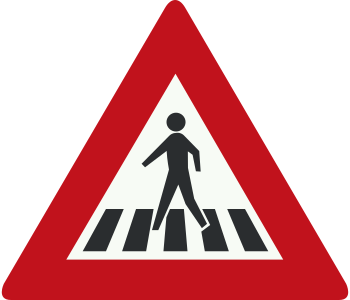
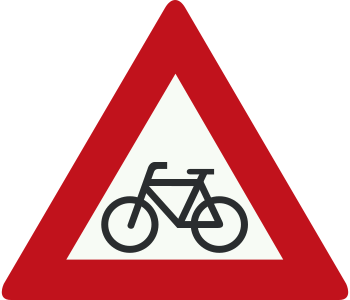
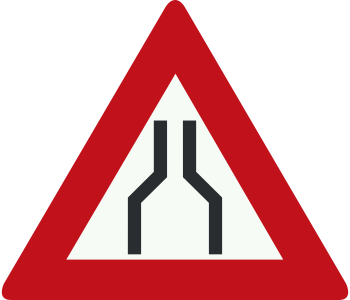
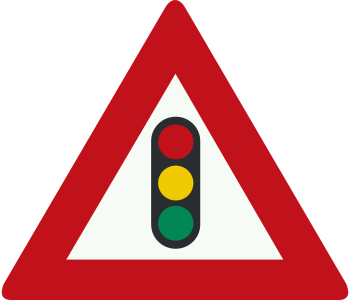
J8 = dangerous crossroads. J10 = level crossing WITH barriers, J11 = WITHOUT. J16 = roadworks, J17 = road narrowing. J22 = pedestrian crossing, J24 = cyclists and moped riders. J32 = traffic lights (Book p.245-246). Every J-sign is a triangle: a warning, not an order or prohibition — you decide your own speed so you can stop in time.
Read this section on its own page: The model: Warning signs J: triangle, not a command
Core
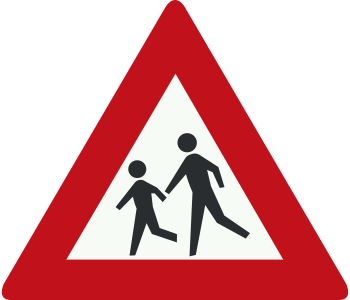
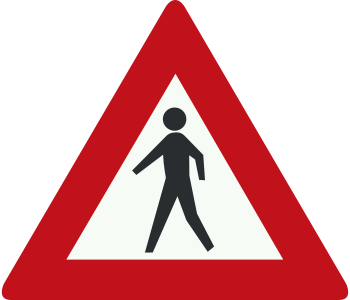
The J category (Book p.245-246) warns of danger without ever giving a command — all J-signs share the same shape: a red triangle with a black symbol. Precisely because the shape is always identical, the knowledge that matters is the code-symbol pairing, not shape recognition. The level-crossing family splits in two: J10 (with barriers) and J11 (without), and is separate from J8, which announces an ordinary dangerous crossroads — no track, no barrier. The roadworks family splits into J16 (roadworks, general) and J17 (specifically a road narrowing). The vulnerable-road-user family splits into J21 (children), J22 (pedestrian crossing — the location, not the people themselves), J23 (pedestrians in general) and J24 (cyclists and moped riders) — four different codes for four different situations, even though they feel like one 'vulnerable traffic' category. What all J-signs have in common: they are not an order or prohibition, so they prescribe no exact speed. Instead, the general rule of the law applies: you must drive so that you can stop within the distance you can see. A J17 road narrowing does not, for example, mandate '50 km/h' — that requirement appears nowhere on the sign.
Read this section on its own page: Core: Warning signs J: triangle, not a command
Why it matters
Whoever confuses J10 with a crossroads doesn't watch extra carefully for a train at an actual level crossing — precisely the hazard the sign is meant to flag. Whoever thinks a J-sign imposes a fixed speed either drives unnecessarily slowly for no legal reason, or too fast because 'there's no number on the sign', while the law in fact does impose a duty to adjust.
Read this section on its own page: Why it matters: Warning signs J: triangle, not a command
Source: RVV 1990 art. 19 · checked 2026-10-22
Frequently asked questions
‘Sign J10 warns of a dangerous crossroads’ – is that true?
No. J10 = level crossing WITH barriers. Dangerous crossroads is J8.
‘Sign J16 warns of a level crossing with barriers’ – is that true?
No. J16 = roadworks. Level crossing with barriers is J10.
‘Sign J22 warns of cyclists and moped riders’ – is that true?
No. J22 = pedestrian crossing. Cyclists and moped riders is J24.
‘Sign J8 (dangerous crossroads) itself regulates who has priority at that crossroads’ – is that true?
No. J-signs are warning signs, not order/prohibition signs; J8 only warns, it does not regulate priority — that follows from B-signs, shark's teeth, or the main rule
‘At sign J17 (road narrowing) you are legally required to a specific, fixed lower speed’ – is that true?
No. A warning sign imposes no fixed speed; you must adjust your speed yourself so that you can stop within the distance you can see