Theory Mastery

Under-signs: explanation, restriction, exemption and distance

What the exam asks here: Under-signs are small and often read as 'extra info, ignorable' — exactly wrong, because they can completely flip a prohibition (exemption) or tie it to time (time window).

14 minutes · 7 sections · 10 questions

The trap

Many learners think: An under-sign with the word 'uitgezonderd' (excepted) plus a bicycle symbol means the traffic sign applies TO cyclists specifically, and only to them.

The rule is: 'uitgezonderd' + symbol = the sign does NOT apply to that group (exemption); a bare symbol without 'uitgezonderd' restricts the sign TO that group instead

Challenge

Under-signs are small and often read as 'extra info, ignorable' — exactly wrong, because they can completely flip a prohibition (exemption) or tie it to time (time window). And any practice material using '600 m' as an example teaches you a number that doesn't exist in this book — the exam designer tests the book's number, not a generic textbook figure.

Read this section on its own page: Challenge: Under-signs: explanation, restriction, exemption and distance

The model

Give a further explanation, restrict the sign to a group (bare symbol), or exempt a group ('uitgezonderd' + symbol). At E-parking signs with times, the ban applies only within that time window. And the book's distance example is 500 metres — not 600 — confirmed on both p.47 and p.252.

Read this section on its own page: The model: Under-signs: explanation, restriction, exemption and distance

Core

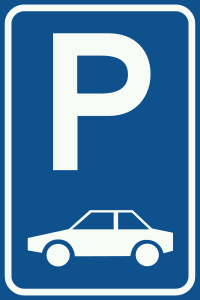
Under-signs do not exist independently: the law opens with 'under-signs placed under traffic signs' — without the main sign above it, an under-sign has no meaning. What exactly the under-sign does depends on the precise text and symbol. If only a symbol appears (no text), that RESTRICTS the main sign to the indicated group or behaviour — for example a truck silhouette restricting a ban to trucks only. If the word 'uitgezonderd' (excepted) appears with a symbol, it flips around: that group is instead EXEMPTED from the ban — the opposite mechanism, with almost the same layout. At E-parking signs (E4 through E8, E12, E13) with days or hours on the under-sign, the order or prohibition applies only within that time window — outside those hours, parking or stopping is simply allowed. The book shows a concrete example: 'Monday through Friday from 8 to 18 hours and Saturday and Sunday from 6 to 24 hours' (Book p.252). For distance under-signs the book consistently uses 500 metres, in two different applications: '500 m' without arrows means 'applies over 500 metres from here', while '↑500 m↑' with arrows on both sides means 'applies for the coming 500 metres' — subtly different wording for two slightly different situations, but the same book figure: 500, never 600.

Read this section on its own page: Core: Under-signs: explanation, restriction, exemption and distance

Why it matters

Whoever reads 'uitgezonderd' as a restriction instead of an exemption wrongly drives onto a prohibited road — or wrongly stops where it's actually allowed. Whoever ignores a time window risks a fine outside the sign's hours, or wrongly parks within the prohibited hours. And whoever remembers '600 metres' as the book figure fails an exam question that literally tests the book's number.

Read this section on its own page: Why it matters: Under-signs: explanation, restriction, exemption and distance

Active recall

Near Harderwijk stands a closure sign with an under-sign below it: the word 'uitgezonderd' plus a bicycle symbol. May a cyclist continue here?

Read this section on its own page: Active recall: Under-signs: explanation, restriction, exemption and distance

Teach back

Explain: what is the difference between a bare symbol on an under-sign and 'uitgezonderd' + symbol, and which distance figure does the book use?

Read this section on its own page: Teach back: Under-signs: explanation, restriction, exemption and distance

Memory hook

Bare symbol = only for them. 'Uitgezonderd' + symbol = specifically not for them. The book figure is always 500 m, never 600.

Read this section on its own page: Memory hook: Under-signs: explanation, restriction, exemption and distance

Source: RVV 1990 art. 24 · RVV 1990 art. 67 · checked 2026-10-22

The picture

Under-signs: three mechanisms, one book figure (500 m)'500 m' (no arrows)'↑500 m↑' (with arrows)Meaning (Book p.47 + p.252)applies over 500 metres (from here)applies for the coming 500 metresBook confirmationp.47 (intro) + p.252 (glossary), identical figurep.47 (intro) + p.252 (glossary), identical figure
What to look at: Under-sign with time=time window. Uitgezonderd+symbol=exemption. '500 m'=from here. '↑500m↑'=coming 500m. '600 m' does not exist in the book.

Signs and law

Test yourself

On the N23 near Lelystad you see a maximum-speed sign with a small white sign below it showing '↑500 m↑'. What does that small sign mean?

Show the answer

Give a further explanation, restrict the sign to a group (bare symbol), or exempt a group ('uitgezonderd' + symbol). At E-parking signs with times, the ban applies only within that time window. And the book's distance example is 500 metres — not 600 — confirmed on both p.47 and p.252.

Exam questions on this topic

Near Harderwijk stands a closure sign with an under-sign below it: the word 'uitgezonderd' plus a bicycle symbol. May a cyclist continue here?

  1. Yes, 'uitgezonderd' + symbol exempts cyclists from the ban
  2. No, 'uitgezonderd' + symbol means the ban applies exclusively to cyclists
Show the answer

Correct answer: Yes, 'uitgezonderd' + symbol exempts cyclists from the ban

'Uitgezonderd' + symbol = that group is EXEMPT, the ban does not apply to them.

Why learners get this wrong: An under-sign with the word 'uitgezonderd' (excepted) plus a bicycle symbol means the traffic sign applies TO cyclists specifically, and only to them.

Open this question

An under-sign with the word 'uitgezonderd' (excepted) plus a bicycle symbol means the traffic sign applies TO cyclists specifically, and only to them.

  1. False
  2. True
Show the answer

Correct answer: False

'uitgezonderd' + symbol = the sign does NOT apply to that group (exemption); a bare symbol without 'uitgezonderd' restricts the sign TO that group instead

Why learners get this wrong: An under-sign with the word 'uitgezonderd' (excepted) plus a bicycle symbol means the traffic sign applies TO cyclists specifically, and only to them.

Open this question

About Under-signs: explanation, restriction, exemption and distance: which statement is correct?

  1. The under-signs '500 m' and '↑500 m↑' mean exactly the same thing: both simply indicate the distance to the main sign.
  2. An under-sign with the word 'uitgezonderd' (excepted) plus a bicycle symbol means the traffic sign applies TO cyclists specifically, and only to them.
  3. If an under-sign at an E-parking sign shows days and hours, the parking ban still applies all week — the under-sign is just extra information.
  4. An under-sign contains a further explanation OF THE TRAFFIC SIGN; without a main sign an under-sign has no independent effect.
Show the answer

Correct answer: An under-sign contains a further explanation OF THE TRAFFIC SIGN; without a main sign an under-sign has no independent effect.

An under-sign contains a further explanation OF THE TRAFFIC SIGN; without a main sign an under-sign has no independent effect

Why learners get this wrong: The under-signs '500 m' and '↑500 m↑' mean exactly the same thing: both simply indicate the distance to the main sign.

Open this question

About Under-signs: explanation, restriction, exemption and distance: which statement is WRONG?

  1. If an under-sign at E4 through E8, E12 or E13 shows days or hours, the orders/prohibitions apply ONLY during those days or hours — outside that window the ban does not apply.
  2. '500 m' (no arrows) = applies over 500 metres from here; '↑500 m↑' (with arrows) = applies for the coming 500 metres — two different applications of the same number, not synonyms.
  3. 'uitgezonderd' + symbol = the sign does NOT apply to that group (exemption); a bare symbol without 'uitgezonderd' restricts the sign TO that group instead.
  4. An under-sign with a symbol applies on its own, even if the main sign above it has been removed or is illegible.
Show the answer

Correct answer: An under-sign with a symbol applies on its own, even if the main sign above it has been removed or is illegible.

An under-sign contains a further explanation OF THE TRAFFIC SIGN; without a main sign an under-sign has no independent effect

Why learners get this wrong: If an under-sign at an E-parking sign shows days and hours, the parking ban still applies all week — the under-sign is just extra information.

Open this question

Below a maximum-speed sign near Zwolle stands an under-sign showing '↑500 m↑'. How many metres does this under-sign indicate?

Show the answer

Correct answer: 500 m

Correct: 500.0 m.

Open this question

Near Deventer a narrow dyke road begins with sign C1 (closed in both directions to vehicles). Below it hangs an under-sign with the word 'uitgezonderd' (except) and a bicycle symbol. You approach in your car, your neighbour on her bicycle. Who may enter the dyke road?

  1. Neither of you; the ban applies to the car and the bicycle
  2. Only you in the car; the ban applies to the bicycle instead
  3. Only your neighbour on the bicycle; the ban applies to your car
Show the answer

Correct answer: Only your neighbour on the bicycle; the ban applies to your car

False — you treat the under-sign as loose explanation. The under-sign belongs to the sign above it and changes what it means: 'uitgezonderd' with a bicycle symbol takes cyclists out of the ban. Your neighbour may enter the dyke road, you in your car may not.

Why learners get this wrong: An under-sign with 'uitgezonderd' and a symbol is only extra explanation; the ban of the sign above it simply applies to that group as well.

Open this question

Near Amersfoort the sign on a pole has disappeared after a collision; only the under-sign with a lorry silhouette is still hanging there. A lorry may not enter this road now, because that under-sign still applies on its own.

  1. True
  2. False
Show the answer

Correct answer: False

False — you let the under-sign apply separately from the sign above it. An under-sign only gives further explanation of the main sign; if that sign is gone, the under-sign has no meaning of its own and prohibits nothing.

Why learners get this wrong: An under-sign with a symbol applies on its own, even if the main sign above it has been removed or is illegible.

Open this question

On a provincial road near Kampen you first see sign J16 (roadworks) with the under-sign '500 m'. Further along there is a speed-limit sign with the under-sign '↑500 m↑'. What does this mean for your drive?

  1. The roadworks start in 500 m; the speed limit applies for the next 500 m
  2. The roadworks run for the next 500 m; the speed limit starts in 500 m
  3. The roadworks and the speed limit both only start in 500 m
Show the answer

Correct answer: The roadworks start in 500 m; the speed limit applies for the next 500 m

False — you ignore the arrows. '500 m' without arrows means the sign applies 500 metres from here; '↑500 m↑' with arrows means the sign applies for the next 500 metres. So the roadworks start in 500 m, while the speed limit applies right away and runs on for 500 m.

Why learners get this wrong: The under-sign '500 m' without arrows means 'applies for the next 500 metres', and '↑500 m↑' with arrows means 'applies 500 metres from here'.

Open this question

In Utrecht a parking space has sign E7 with an under-sign: 'Mon-Fri 08-18h Sat/Sun 06-24h'. It is Wednesday, 20:00, and you want to park your car here. Is that allowed?

  1. No — 20:00 is inside 06-24h, and that window also applies on weekdays
  2. Yes — Wednesday 20:00 is outside 08-18h, so the sign does not apply now
  3. No — the under-sign is only extra information; the sign applies 24 hours a day
Show the answer

Correct answer: Yes — Wednesday 20:00 is outside 08-18h, so the sign does not apply now

False — you ignore the time window. If the under-sign shows days or hours, the sign applies only on those days and hours; on a weekday after 18:00 it does not apply here. (VekaBest theorieboek, Hoofdstuk 3 §3.1 p.47 + Hoofdstuk 14 '4 Onderborden' p.251-252)

Why learners get this wrong: If an under-sign shows two time windows, the widest window applies on every day of the week.

Open this question

In a residential area in Ede there is a no-parking sign with an under-sign below it showing only a lorry silhouette, without text. You want to park your car there. What applies?

  1. You may park here; the ban applies only to lorries
  2. You may not park here; only lorries may stand here
  3. You may not park here; the under-sign is just extra explanation
Show the answer

Correct answer: You may park here; the ban applies only to lorries

False — you treat the under-sign as a side issue. An under-sign with only a symbol decides who the sign applies to: this parking ban applies only to lorries, so you may park your car here.

Why learners get this wrong: An under-sign with the word 'uitgezonderd' (excepted) plus a bicycle symbol means the traffic sign applies TO cyclists specifically, and only to them.

Open this question

Frequently asked questions

‘An under-sign with the word 'uitgezonderd' (excepted) plus a bicycle symbol means the traffic sign applies TO cyclists specifically, and only to them’ – is that true?

No. 'uitgezonderd' + symbol = the sign does NOT apply to that group (exemption); a bare symbol without 'uitgezonderd' restricts the sign TO that group instead

‘An under-sign with a symbol applies on its own, even if the main sign above it has been removed or is illegible’ – is that true?

No. An under-sign contains a further explanation OF THE TRAFFIC SIGN; without a main sign an under-sign has no independent effect

‘The under-signs '500 m' and '↑500 m↑' mean exactly the same thing: both simply indicate the distance to the main sign’ – is that true?

No. '500 m' (no arrows) = applies over 500 metres from here; '↑500 m↑' (with arrows) = applies for the coming 500 metres — two different applications of the same number, not synonyms

‘If an under-sign at an E-parking sign shows days and hours, the parking ban still applies all week — the under-sign is just extra information’ – is that true?

No. If an under-sign at E4 through E8, E12 or E13 shows days or hours, the orders/prohibitions apply ONLY during those days or hours — outside that window the ban does not apply

‘If an under-sign shows two time windows, the widest window applies on every day of the week’ – is that true?

No. Each time window belongs to the days written before it; outside those days and hours the sign does not apply (book example 'Mon-Fri 08-18h Sat/Sun 06-24h').
Related topics

Open in the app