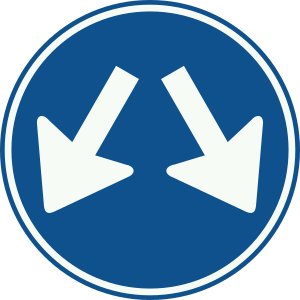
Sign D3: The sign or obstacle may be passed on either side.
Legal meaning
The sign may be passed on either side.
Shape and colour
Round blue sign with two downward arrows: the sign or obstacle may be passed on the left and on the right.
Where the sign stands
On the nose of the traffic island or obstacle that may be passed on either side.
What the exam asks about this sign
The exam asks on which side you must pass a traffic island with this sign: both sides are allowed, you choose the side that suits your direction. Trap: candidates confuse it with the single-arrow sign (pass on one side only). A second question: may you pass on the left when going straight on? Yes, at D3 you may, but watch oncoming traffic.
Often confused with
- Mandatory: pick one shown direction; pass obstacle left or right.
D7— Two arrows left and right: turn, no passing rule. - Mandatory direction shown on the sign: straight ahead here.
D4— Arrow straight up: order to go straight, no passing rule. - Mandatory: one of the shown directions, e.g. straight or turn.
D6— Two arrows: straight or turn, no passing rule.
Signs in the same series
- Roundabout with mandatory direction, follow the sign.
D1_zb - Mandatory direction shown on the sign: straight ahead here.
D4 - Mandatory direction shown: turn here, follow the arrow.
D5 - Mandatory: one of the shown directions, e.g. straight or turn.
D6 - Mandatory: pick one shown direction; pass obstacle left or right.
D7