Theory Mastery

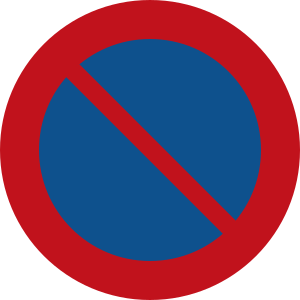
Sign E1: No parking

E1 – No parking

Series: E -- Parking and stopping

Legal meaning

No parking.

Source: RVV 1990 annex 1 · checked 2026-10-23

Shape and colour

Round blue sign with a red rim and one red diagonal bar: no parking on this side of the road.

Where the sign stands

On the side without parking bays, at the start of the stretch; the ban applies to that side of the road only.

Supplementary plates with this sign

What the exam asks about this sign

The exam asks what parking is and what is not: stopping to let passengers in or out or to load and unload at once is allowed at E1, any other standing still is parking and is not. Trap: candidates confuse E1 with E2 (no stopping), where even a brief wait is forbidden. The sign covers only the side of the road where it stands, up to the next junction.

Trap

Thinking E1 and E2 both ban all stopping.

E1 bans parking only (loading/unloading OK); E2 bans all stopping, even briefly.

Exam question on this sign

About Sign E1 and E2: parking ban or standing-still ban: which statement is WRONG?

  1. The book states explicitly: 'You may still stand still to load/unload or to let a passenger get in/out.'.
  2. It is exactly the reverse. Sign E1 (one diagonal stripe) = parking ban: standing still for loading/unloading or getting in/out is still allowed. Sign E2 (two crossed stripes, a cross) = standing-still ban: that forbids EVERYTHING, including loading/unloading.
  3. A sign E1 or E2 alongside the road applies to both directions of travel / both sides of the road.
  4. With E2 'you may not stand still afterwards (and therefore not park either)' — with no exception for loading/unloading.
Show the answer

Correct answer: A sign E1 or E2 alongside the road applies to both directions of travel / both sides of the road.

'these signs only apply to the side of the road where they stand'. The opposite side can have a completely different situation

Why learners get this wrong: With sign E1, you may also no longer stand still to load/unload or let a passenger in/out.

Open this question

Often confused with

Signs in the same series

Where this is explained

Topics that use this sign

Questions using this

Open in the app