The trap
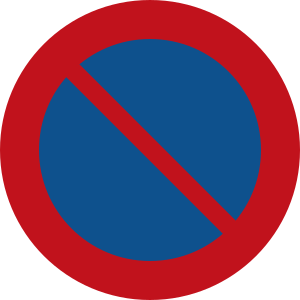
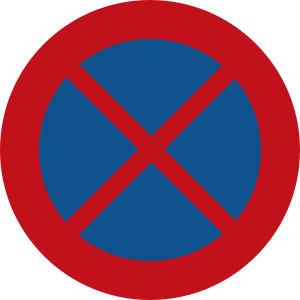
Many learners think: Sign E1 forbids all standing still (including loading/unloading), and sign E2 only forbids parking but still allows standing still.
The rule is: It is exactly the reverse. Sign E1 (one diagonal stripe) = parking ban: standing still for loading/unloading or getting in/out is still allowed. Sign E2 (two crossed stripes, a cross) = standing-still ban: that forbids EVERYTHING, including loading/unloading
Challenge
Many learners flip the two signs around in their heads: they think the sign with ONE stripe is the strictest (because 'number one comes first, so it's heaviest'), and that the sign with the CROSS still leaves room. It is exactly the reverse. The CBR exam designer knows this inversion is widespread — and tests it head-on precisely because of that.
Read this section on its own page: Challenge: Sign E1 and E2: parking ban or standing-still ban
The model
Sign E1 (one diagonal stripe) = parking ban. You may still stand still there to load/unload or let a passenger in/out (Book p.160). Sign E2 (two crossed stripes, a cross) = standing-still ban. That forbids everything — loading/unloading too, parking too.
Read this section on its own page: The model: Sign E1 and E2: parking ban or standing-still ban
Core
The distinction between the two signs builds directly on standing still versus parking (see definitie.onderscheid): E1 only forbids parking — the standing-still exception (immediate loading/unloading, or letting a passenger in/out) remains simply allowed. E2 forbids standing still itself — and because parking is a form of standing still that falls outside the exception, E2 automatically forbids parking too. The memory hook is in the icon, not the sequence number: one stripe at E1 still leaves a crack open; the cross at E2 (two stripes crossing each other) shuts everything. Both signs only apply to the side of the road where they stand (Book p.160) — the other side of the street can have a completely different rule. And sub-signs refine the ban further: an arrow limits it to the direction of the arrow, numbers limit it to specific days of the month.
Read this section on its own page: Core: Sign E1 and E2: parking ban or standing-still ban
Why it matters
The confusion between E1 and E2 is not a theoretical detail — in practice, for example when restocking a shop in the centre of Woerden, it decides whether you may or may not stop to unload boxes. Guessing wrong at E2 (thinking you may load/unload) earns a fine for an illegal stand; guessing wrong at E1 (thinking you cannot stop at all) means needlessly parking further away and walking.
Read this section on its own page: Why it matters: Sign E1 and E2: parking ban or standing-still ban
Frequently asked questions
‘Sign E1 forbids all standing still (including loading/unloading), and sign E2 only forbids parking but still allows standing still’ – is that true?
No. It is exactly the reverse. Sign E1 (one diagonal stripe) = parking ban: standing still for loading/unloading or getting in/out is still allowed. Sign E2 (two crossed stripes, a cross) = standing-still ban: that forbids EVERYTHING, including loading/unloading
‘With sign E1, you may also no longer stand still to load/unload or let a passenger in/out’ – is that true?
No. The book states explicitly: 'You may still stand still to load/unload or to let a passenger get in/out.' E1 forbids only parking
‘With sign E2, you may still briefly stand still to load/unload, as long as it is quick’ – is that true?
No. With E2 'you may not stand still afterwards (and therefore not park either)' — with no exception for loading/unloading. E2 is stricter than E1, not equal to it
‘A sign E1 or E2 alongside the road applies to both directions of travel / both sides of the road’ – is that true?
No. 'these signs only apply to the side of the road where they stand'. The opposite side can have a completely different situation