Theory Mastery

Keeping right, road narrowing (F5/F6) and obstacles

What the exam asks here: Red feels like 'danger, so pay extra attention and drive through' — like a traffic light that just turned amber and you can still make it.

14 minutes · 7 sections · 9 questions

The trap

Many learners think: Keeping right means driving as close as possible to the kerb or the verge.

The rule is: You must keep right as much as possible, but do not drive too close to the kerb or the verge; if the road is too narrow for you and an oncoming driver, you both move aside

Challenge

Red feels like 'danger, so pay extra attention and drive through' — like a traffic light that just turned amber and you can still make it. At sign F5-F6 it works exactly the other way around: the colour itself, not your gut feeling about that colour, decides who stops.

Read this section on its own page: Challenge: Keeping right, road narrowing (F5/F6) and obstacles

The model

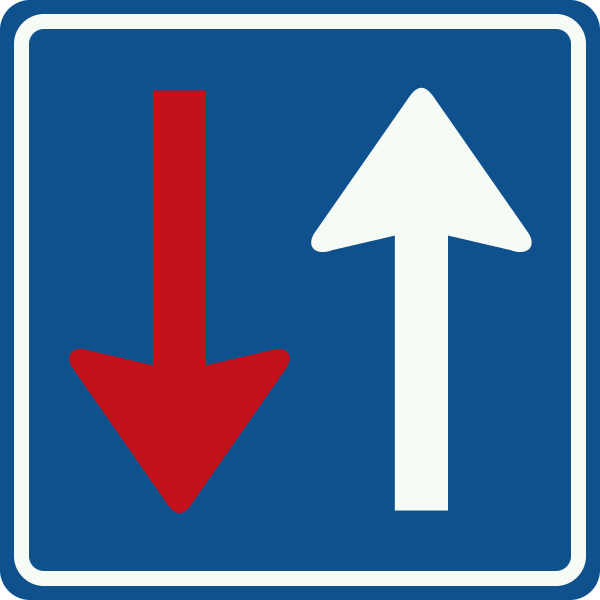
If you are driving in the direction of the red arrow (sign F5), you stop (Book p.60). If you are driving in the direction of the white arrow (sign F6), your oncoming driver stops — you may proceed. These signs apply only between drivers.

Read this section on its own page: The model: Keeping right, road narrowing (F5/F6) and obstacles

Core

The basics: you must keep right as much as possible, but not drive too close to the kerb or the verge. If the road is too narrow for you and an oncoming driver, you both move aside (Book p.60). At a road narrowing, signs F5-F6 usually decide who goes first: if you are driving toward the red arrow, you stop; if you are driving toward the white arrow, your oncoming driver stops. These signs apply only between drivers, not for example toward pedestrians (Book p.60). If there is no sign, the same basic logic without an arrow applies to an obstacle: when there is not enough room, whoever has the obstacle on their own half of the road must stop. If the obstacle is on the oncoming driver's half of the road, that driver stops — not you (Book p.61).

Read this section on its own page: Core: Keeping right, road narrowing (F5/F6) and obstacles

Why it matters

These rules prevent exactly the kind of misunderstanding that leads to a head-on situation at a narrow bridge or an obstacle: if both drivers assume the OTHER one will stop, they both keep driving. The F5/F6 colours and the half-of-the-road rule for obstacles give one unambiguous answer to 'who stops here' — no negotiation needed in the moment itself.

Read this section on its own page: Why it matters: Keeping right, road narrowing (F5/F6) and obstacles

Active recall

On the narrow bridge near Bennekom you are driving in the direction of the red arrow on sign F5. An oncoming driver is approaching from the other side. Who stops?

Read this section on its own page: Active recall: Keeping right, road narrowing (F5/F6) and obstacles

Teach back

Explain: what do the red and white arrows at sign F5-F6 mean, and which rule applies to an obstacle when there is no sign?

Read this section on its own page: Teach back: Keeping right, road narrowing (F5/F6) and obstacles

Memory hook

Red = you stop · white = you proceed (F5/F6). No sign? Obstacle on YOUR half = YOU stop. Keep right: as much as possible, but not against the kerb/verge.

Read this section on its own page: Memory hook: Keeping right, road narrowing (F5/F6) and obstacles

Source: RVV 1990 art. 3 · checked 2026-10-22

The picture

Sign F5 versus F6 at a road narrowing: who stops, who may proceedSign F5 (p.60)Sign F6 (p.60)Arrow colour facing youredwhiteWhat you dostop, oncoming driver goes firstdrive through, oncoming driver stops
What to look at: Sign F5: red arrow facing you = you stop. Sign F6: white arrow facing you = you may drive through. Applies only between drivers.

Signs and law

Test yourself

On a country lane near Bennekom you drive toward a narrow bridge over a ditch. Right at the bridge there is a yellow-black sign with a red arrow pointing down. An oncoming driver is approaching the same bridge from the other side. Who has to stop?

Show the answer

If you are driving in the direction of the red arrow (sign F5), you stop (Book p.60). If you are driving in the direction of the white arrow (sign F6), your oncoming driver stops — you may proceed. These signs apply only between drivers.

Exam questions on this topic

On the narrow bridge near Bennekom you are driving in the direction of the red arrow on sign F5. An oncoming driver is approaching from the other side. Who stops?

  1. The oncoming driver stops, you may proceed
  2. You stop, the oncoming driver may proceed
Show the answer

Correct answer: You stop, the oncoming driver may proceed

If you are driving toward the red arrow, you stop; the white-arrow side may proceed

Why learners get this wrong: At sign F5-F6, the red arrow means you may drive through and the white arrow means you must stop.

Open this question

If you are driving in the direction of the red arrow, you must stop; if you are driving in the direction of the white arrow, the oncoming drivers — not you — must stop.

  1. False
  2. True
Show the answer

Correct answer: True

If you are driving in the direction of the red arrow, you must stop; if you are driving in the direction of the white arrow, the oncoming drivers — not you — must stop. Red = you stop, white = you may proceed

Why learners get this wrong: At sign F5-F6, the red arrow means you may drive through and the white arrow means you must stop.

Open this question

About Keeping right, road narrowing (F5/F6) and obstacles: which statement is WRONG?

  1. Keeping right means driving as close as possible to the kerb or the verge.
  2. If you are driving in the direction of the red arrow, you must stop; if you are driving in the direction of the white arrow, the oncoming drivers — not you — must stop.
  3. When there is not enough room, whoever has the obstacle on their own half of the road must stop; if the obstacle is on the oncoming driver's half of the road, that driver stops, not you.
  4. The same basic rules apply to obstacles as to a road narrowing without a sign: whoever has the obstacle on their own half of the road stops when there is not enough room.
Show the answer

Correct answer: Keeping right means driving as close as possible to the kerb or the verge.

You must keep right as much as possible, but do not drive too close to the kerb or the verge; if the road is too narrow for you and an oncoming driver, you both move aside

Why learners get this wrong: At sign F5-F6, the red arrow means you may drive through and the white arrow means you must stop.

Open this question

On the narrow bridge near Bennekom you are driving in the direction of the red arrow on sign F5. An oncoming driver is approaching from the other side. Who must stop?

  1. You stop, the oncoming driver may proceed
  2. The oncoming driver stops, you may proceed
Show the answer

Correct answer: You stop, the oncoming driver may proceed

Why learners get this wrong: At sign F5-F6, the red arrow means you may drive through and the white arrow means you must stop.

Open this question

Statement: keeping right on a country lane near Bennekom means driving as close as possible to the verge.

  1. True
  2. False
Show the answer

Correct answer: False

Why learners get this wrong: Keeping right means driving as close as possible to the kerb or the verge.

Open this question

On the country lane near Bennekom a fallen branch lies on your own half of the road. No sign in sight. An oncoming driver is approaching and there is not enough room for both of you at once. Who must stop?

  1. The oncoming driver, because they must stop at an obstacle
  2. You, because the obstacle is on your own half of the road
Show the answer

Correct answer: You, because the obstacle is on your own half of the road

Why learners get this wrong: At an obstacle on the road, it is always the oncoming driver who must stop, never you.

Open this question

Statement: the give-way rule for obstacles (whoever has the obstacle on their half of the road stops) only applies if there is an F5-F6 sign.

  1. True
  2. False
Show the answer

Correct answer: False

Why learners get this wrong: The obstacle give-way rule only applies if there is an F5-F6 sign; without a sign there is no fixed rule.

Open this question

Which of the following descriptions of sign F5-F6 are correct? (select all that apply)

  1. A red arrow facing you means you stop
  2. A red arrow facing you means you may proceed
  3. A white arrow facing you means you may proceed
  4. The signs also apply toward pedestrians crossing
Show the answer

Correct answer: A red arrow facing you means you stop; A white arrow facing you means you may proceed

False — ly selected

Why learners get this wrong: At sign F5-F6, the red arrow means you may drive through and the white arrow means you must stop.

Open this question

On the country lane near Bennekom the road is too narrow for your car and an oncoming driver at the same time, and there is no sign at all. What must happen?

  1. You both move aside, neither of you automatically has priority
  2. Only the oncoming driver moves aside, you were on the road first
Show the answer

Correct answer: You both move aside, neither of you automatically has priority

Why learners get this wrong: If a road is too narrow for two cars and there is no sign, the driver who was on it first need not move aside.

Open this question

Frequently asked questions

‘Keeping right means driving as close as possible to the kerb or the verge’ – is that true?

No. You must keep right as much as possible, but do not drive too close to the kerb or the verge; if the road is too narrow for you and an oncoming driver, you both move aside

‘At sign F5-F6, the red arrow means you may drive through and the white arrow means you must stop’ – is that true?

No. If you are driving in the direction of the red arrow, you must stop; if you are driving in the direction of the white arrow, the oncoming drivers — not you — must stop. Red = you stop, white = you may proceed

‘At an obstacle on the road, it is always the oncoming driver who must stop, never you’ – is that true?

No. When there is not enough room, whoever has the obstacle on their own half of the road must stop; if the obstacle is on the oncoming driver's half of the road, that driver stops, not you

‘The obstacle give-way rule only applies if there is an F5-F6 sign; without a sign there is no fixed rule’ – is that true?

No. The same basic rules apply to obstacles as to a road narrowing without a sign: whoever has the obstacle on their own half of the road stops when there is not enough room. This rule applies even without sign F5-F6

‘Signs F5 and F6 also decide who goes first in relation to crossing pedestrians’ – is that true?

No. These signs apply only between drivers, not toward pedestrians
Related topics

Open in the app