Theory Mastery

Overtaking: the F1 sign and the five exceptions to left-overtaking

What the exam asks here: Almost every student answers 'yes, blue' — it is the colour everyone remembers from mandatory-direction signs.

14 minutes · 7 sections · 13 questions

The trap

Many learners think: The 'no overtaking' sign (F1) is a round sign with a BLUE background.

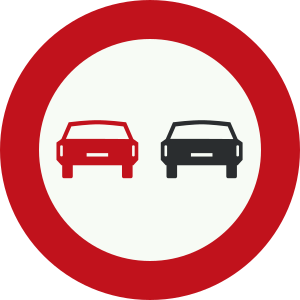
The rule is: The icon is unambiguously a RED border on a WHITE background, with a black car overtaking a red car. Red border = prohibition sign, like the rest of the F-series (F1-F4)

Challenge

Almost every student answers 'yes, blue' — it is the colour everyone remembers from mandatory-direction signs. The CBR exam designer counts on exactly that: whoever has the sign's colour wrong also misses why agricultural vehicles may still pass it, and why there are four other ways to overtake on the right without ever seeing this sign at all.

Read this section on its own page: Challenge: Overtaking: the F1 sign and the five exceptions to left-overtaking

The model

No — the F1 sign has a RED border and a WHITE background, not a blue background (Book p.145). And overtaking on the right is also possible without this sign: right before/at roundabouts, to the right of a block marking, in a traffic jam, past a left-pre-sorting driver, or past a tram — five exceptions to the 'overtake on the left' rule (Book p.141).

Read this section on its own page: The model: Overtaking: the F1 sign and the five exceptions to left-overtaking

Core

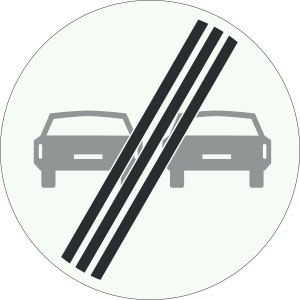
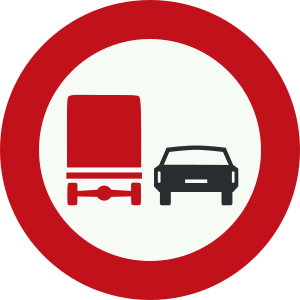
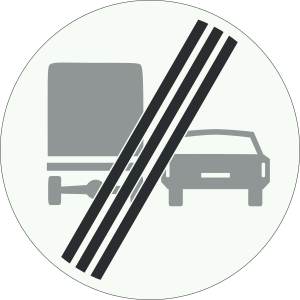
First the distinction the book itself makes (Book p.140): overtaking (inhalen) is passing a moving driver going the same direction; passing (voorbijgaan) is passing something stationary — a parked vehicle, an obstacle, a pedestrian. The main rule is: overtake on the left. Overtaking on the right is only allowed in five, explicitly named, cases (Book p.141): right before and at roundabouts; when you are driving to the right of a block marking; when overtaking a traffic jam; when the driver being overtaken has already pre-sorted left and is signalling left; when the vehicle being overtaken is a tram. The F1 sign belongs to the overtake-on-the-left main rule: it is a round sign with a RED border and a WHITE background, showing a black car overtaking a red car (Book p.145) — not a blue sign. It prohibits motor vehicles from overtaking EACH OTHER; agricultural vehicles may still be overtaken at this sign. F2 shows the end of that prohibition (grey/white with a diagonal stripe); F3 is the same prohibition but specifically for lorries (red border, truck icons); F4 shows the end of that one. Two other places where overtaking is prohibited regardless of any sign: right before or at a pedestrian crossing (zebra crossing), and at a solid line between lanes — unless that line is combined with a dashed line on YOUR side, in which case you may overtake.

Read this section on its own page: Core: Overtaking: the F1 sign and the five exceptions to left-overtaking

Why it matters

Whoever misreads the F1 sign misses the exact moment overtaking becomes prohibited — and on the narrow provincial roads around Kruiningen, where verges are absent and oncoming traffic passes close by, that is exactly where a mistake here becomes life-threatening. And whoever only knows the traffic-jam exception overlooks the other four safe right-overtaking opportunities, or worse: tries to overtake on the left at a roundabout where that is not the intended manoeuvre at all.

Read this section on its own page: Why it matters: Overtaking: the F1 sign and the five exceptions to left-overtaking

Active recall

Near Yerseke you are driving on a road with a solid line between the lanes. A cyclist with luggage is riding slowly ahead of you. May you overtake?

Read this section on its own page: Active recall: Overtaking: the F1 sign and the five exceptions to left-overtaking

Teach back

Explain: what colour is the F1 sign really, and name the five exceptions where you may overtake on the right without ever seeing that sign.

Read this section on its own page: Teach back: Overtaking: the F1 sign and the five exceptions to left-overtaking

Memory hook

F1 = red-white, not blue. Overtaking on the right is allowed at: roundabout, block marking, traffic jam, a left-pre-sorting driver, a tram.

Read this section on its own page: Memory hook: Overtaking: the F1 sign and the five exceptions to left-overtaking

The picture

F1 sign: red-white, not blue — and the 5 exceptions to left-overtakingWhat many students think (p.145)What the book shows (p.145)Colour of the border/backgroundround, blue backgroundround, red border, white backgroundApplies to agricultural vehicles?yes, they may not be overtaken eitherno — agricultural vehicles may still be overtakenOvertaking on the right without this signonly in a traffic jam / slow traffic5 cases: roundabout, block marking, traffic jam, left-pre-sorting driver, tram
What to look at: F1 is red-white, not blue. Overtaking on the right is allowed at: roundabout, block marking, traffic jam, a left-pre-sorting driver, a tram.

Signs and law

Test yourself

On the provincial road near Wemeldinge you are driving behind a slow truck and see a round sign with a car overtaking another car. Your passenger says: 'That's a blue sign, right?' Is that correct?

Show the answer

No — the F1 sign has a RED border and a WHITE background, not a blue background (Book p.145). And overtaking on the right is also possible without this sign: right before/at roundabouts, to the right of a block marking, in a traffic jam, past a left-pre-sorting driver, or past a tram — five exceptions to the 'overtake on the left' rule (Book p.141).

Exam questions on this topic

Near Yerseke you are driving on a road with a solid line between the lanes. A cyclist with luggage is riding slowly ahead of you. May you overtake?

  1. No, not while the solid line is on your side without a dashed line next to it
  2. Yes, overtaking a cyclist is always allowed, regardless of the road marking
Show the answer

Correct answer: No, not while the solid line is on your side without a dashed line next to it

You may not cross a solid line, not even for a cyclist, unless the marking is combined with a dashed line on your side

Why learners get this wrong: At a combined line (one dashed, one solid) you may never overtake, whichever side you are driving on.

Open this question

At a combined line you may overtake if the DASHED line is on your side; the prohibition only applies if the solid line is on your side.

  1. False
  2. True
Show the answer

Correct answer: True

At a combined line you may overtake if the DASHED line is on your side; the prohibition only applies if the solid line is on your side

Why learners get this wrong: At a combined line (one dashed, one solid) you may never overtake, whichever side you are driving on.

Open this question

About Overtaking: the F1 sign and the five exceptions to left-overtaking: which statements are correct? (multiple answers possible)

  1. At a combined line you may overtake if the DASHED line is on your side; the prohibition only applies if the solid line is on your side.
  2. The icon is unambiguously a RED border on a WHITE background, with a black car overtaking a red car.
  3. If impatient traffic is waiting behind you, you may exceptionally overtake at sign F1 after all.
  4. The 'no overtaking' sign (F1) has a green border.
Show the answer

Correct answer: At a combined line you may overtake if the DASHED line is on your side; the prohibition only applies if the solid line is on your side.; The icon is unambiguously a RED border on a WHITE background, with a black car overtaking a red car.

Green does not appear in the F-series prohibition signs

Why learners get this wrong: If impatient traffic is waiting behind you, you may exceptionally overtake at sign F1 after all.

Open this question

About Overtaking: the F1 sign and the five exceptions to left-overtaking: which statement is correct?

  1. Overtaking on the right is allowed only when the driver on your left signals or positions to turn left; there are no other cases.
  2. The 'no overtaking' sign (F1) is a round sign with a BLUE background.
  3. Overtaking on the right is only allowed with stationary or slow-moving traffic, such as in a traffic jam.
  4. F1 prohibits motor vehicles from overtaking EACH OTHER; agricultural vehicles may still be overtaken at this sign.
Show the answer

Correct answer: F1 prohibits motor vehicles from overtaking EACH OTHER; agricultural vehicles may still be overtaken at this sign.

F1 prohibits motor vehicles from overtaking EACH OTHER; agricultural vehicles may still be overtaken at this sign

Why learners get this wrong: Overtaking on the right is allowed only when the driver on your left signals or positions to turn left; there are no other cases.

Open this question

About Overtaking: the F1 sign and the five exceptions to left-overtaking: which statement is WRONG?

  1. The icon is unambiguously a RED border on a WHITE background, with a black car overtaking a red car.
  2. There are FIVE exceptions: right before/at roundabouts, driving to the right of a block marking, overtaking a traffic jam, a driver who has signalled left and pre-sorted left, and overtaking a tram.
  3. At the F1 sign (no overtaking) you may also not overtake an agricultural vehicle.
  4. Pressure from following traffic is not a recognised exception to the F1 sign.
Show the answer

Correct answer: At the F1 sign (no overtaking) you may also not overtake an agricultural vehicle.

F1 prohibits motor vehicles from overtaking EACH OTHER; agricultural vehicles may still be overtaken at this sign

Why learners get this wrong: The 'no overtaking' sign (F1) is a round sign with a BLUE background.

Open this question

About Overtaking: the F1 sign and the five exceptions to left-overtaking: which statement is WRONG?

  1. There are FIVE exceptions: right before/at roundabouts, driving to the right of a block marking, overtaking a traffic jam, a driver who has signalled left and pre-sorted left, and overtaking a tram.
  2. F1 prohibits motor vehicles from overtaking EACH OTHER; agricultural vehicles may still be overtaken at this sign.
  3. Overtaking at a pedestrian crossing (zebra crossing) is only prohibited if there is a no-overtaking sign.
  4. The icon is unambiguously a RED border on a WHITE background, with a black car overtaking a red car.
Show the answer

Correct answer: Overtaking at a pedestrian crossing (zebra crossing) is only prohibited if there is a no-overtaking sign.

Right before or at a pedestrian crossing overtaking is ALWAYS prohibited, even without a no-overtaking sign
Why learners get this wrong: Overtaking on the right is only allowed with stationary or slow-moving traffic, such as in a traffic jam.

Open this question

Right before or at a pedestrian crossing overtaking is ALWAYS prohibited, even without a no-overtaking sign.

  1. False
  2. True
Show the answer

Correct answer: True

Right before or at a pedestrian crossing overtaking is ALWAYS prohibited, even without a no-overtaking sign
Why learners get this wrong: Overtaking at a pedestrian crossing (zebra crossing) is only prohibited if there is a no-overtaking sign.

Open this question

Near Kapelle you see a round sign with a black car overtaking a red car. What colour is the border of this sign?

  1. Green
  2. Red
  3. Blue
Show the answer

Correct answer: Red

Why learners get this wrong: The 'no overtaking' sign (F1) has a green border.

Open this question

Statement: at the F1 sign (no overtaking) near Wolphaartsdijk you may also not overtake an agricultural vehicle.

  1. True
  2. False
Show the answer

Correct answer: False

Why learners get this wrong: At the F1 sign (no overtaking) you may also not overtake an agricultural vehicle.

Open this question

Near Kortgene you approach a roundabout on a road with two lanes. There is no no-overtaking sign, no traffic jam, and the car in the left lane is not signalling. Right before the roundabout you want to pass it in the right lane. Is that allowed?

  1. No, overtaking on the right is only allowed in a jam or slow traffic
  2. Yes, right before and on a roundabout you may overtake on the right
  3. Only if the car to your left is also signalling to the left
Show the answer

Correct answer: Yes, right before and on a roundabout you may overtake on the right

False — here too you take one exception for the whole rule. A car that has moved left and signals left is one of the five cases; right before and on a roundabout you may overtake on the right without that as well

Why learners get this wrong: Overtaking on the right is only allowed with stationary or slow-moving traffic, such as in a traffic jam.

Open this question

All practice questions of this topic

Frequently asked questions

‘The 'no overtaking' sign (F1) is a round sign with a BLUE background’ – is that true?

No. The icon is unambiguously a RED border on a WHITE background, with a black car overtaking a red car. Red border = prohibition sign, like the rest of the F-series (F1-F4)

‘Overtaking on the right is only allowed with stationary or slow-moving traffic, such as in a traffic jam’ – is that true?

No. There are FIVE exceptions: right before/at roundabouts, driving to the right of a block marking, overtaking a traffic jam, a driver who has signalled left and pre-sorted left, and overtaking a tram. The traffic jam is only one of them

‘At the F1 sign (no overtaking) you may also not overtake an agricultural vehicle’ – is that true?

No. F1 prohibits motor vehicles from overtaking EACH OTHER; agricultural vehicles may still be overtaken at this sign

‘At a combined line (one dashed, one solid) you may never overtake, whichever side you are driving on’ – is that true?

No. At a combined line you may overtake if the DASHED line is on your side; the prohibition only applies if the solid line is on your side

‘Overtaking at a pedestrian crossing (zebra crossing) is only prohibited if there is a no-overtaking sign’ – is that true?

No. Right before or at a pedestrian crossing overtaking is ALWAYS prohibited, even without a no-overtaking sign
Related topics

Open in the app