Challenge
Most students know the marker posts exist, but not exactly what the stripes mean — they estimate by feel. The CBR exam designer counts on that: every stripe stands for exactly the same number of metres, and whoever doesn't know that also misses why two Saint Andrew's crosses mean something quite different from two crossings.
Read this section on its own page: Challenge: Level crossing: markers, the Saint Andrew's cross, and the red flashing light
The model
Every diagonal stripe on a marker post stands for 80 metres: three stripes at 240 m, two stripes at 160 m, one stripe at 80 m before the crossing (Book p.95). Right before the crossing itself stands a Saint Andrew's cross: one cross = one track, two crosses = two or more tracks at that same crossing. As soon as the lights flash red and the bell rings, you stop immediately (Book p.94) — not only once the barriers start lowering.
Read this section on its own page: The model: Level crossing: markers, the Saint Andrew's cross, and the red flashing light
Core
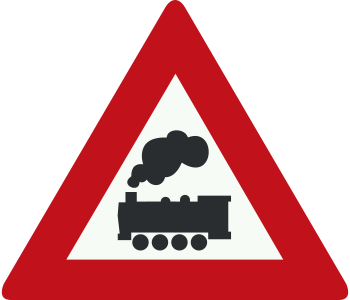
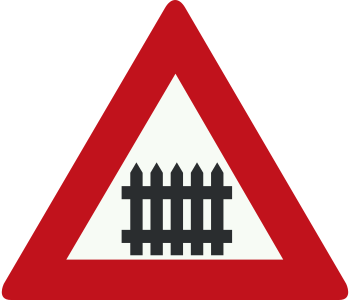
A level crossing (Book p.94) is an at-grade intersection between a road and a railway. Sign J10 (gate symbol) belongs to a crossing WITH barriers; sign J11 (locomotive symbol) to a crossing WITHOUT barriers, but with the same flashing lights and alarm bells. The stop moment is identical in both cases: as soon as the lights start flashing red and the bell rings, you stop — the barriers, if present, only lower a few seconds later. The three marker posts before the crossing give you an exact distance measurement, not a vague warning: three stripes at 240 metres, two stripes at 160 metres, one stripe at 80 metres (Book p.95). This lets you adjust your speed in good time, before you even see the red light. Right before the crossing itself, the Saint Andrew's cross tells you something different: not the distance, but the number of tracks. One cross means one track — look carefully once. Two crosses mean two or more tracks at that same crossing — a train on the far track can hide behind a train on the near track, so look again after passing the first rails. Overtaking just before or on a level crossing is not a legal prohibition like at a zebra crossing, but advice: you'd better not. Overtaking cyclists there is sometimes an exception, if there is enough room and visibility (Book p.96) — it is then better for traffic flow.
Read this section on its own page: Core: Level crossing: markers, the Saint Andrew's cross, and the red flashing light
Why it matters
A train cannot swerve and needs a stopping distance of hundreds of metres — the marker posts and the Saint Andrew's cross give you the information you need before the situation becomes acute. Someone who only reacts once the barriers start lowering often brakes too late on a wet country road near Meppel. And someone who drives straight on after the first train at a two-track crossing risks meeting a second, hidden train — exactly why the Saint Andrew's cross reports the number of tracks, not just 'watch out'.
Read this section on its own page: Why it matters: Level crossing: markers, the Saint Andrew's cross, and the red flashing light
Source: RVV 1990 art. 78 · checked 2026-10-22
Frequently asked questions
‘You only need to stop for a level crossing once the barriers start to lower, not already at the red flashing light’ – is that true?
No. You must stop as soon as the crossing lights start flashing red and the alarm bells start ringing; the barriers only lower a few seconds later
‘A level crossing without barriers (recognisable by the locomotive-symbol sign) is less dangerous, so you may drive over it faster’ – is that true?
No. Both types of level crossing have flashing lights and alarm bells; the only difference is the presence or absence of barriers. The red-flashing-light stop duty applies in exactly the same way at a J11 crossing
‘Every level-crossing marker post stands at the same distance from the crossing, regardless of how many stripes it has’ – is that true?
No. Each diagonal stripe represents 80 metres: three stripes at 240 m, two stripes at 160 m, one stripe at 80 m before the crossing
‘Two Saint Andrew's crosses on one post mean there are two separate level crossings right after each other’ – is that true?
No. One Saint Andrew's cross means one track, two crosses mean two OR MORE tracks at that same crossing — not two crossings
‘Overtaking just before or on a level crossing is legally prohibited, just like at a pedestrian crossing (zebra crossing)’ – is that true?
No. At a level crossing it is advisory ('you'd better not'), not a hard prohibition; overtaking cyclists is even sometimes an exception with sufficient room and visibility. At a zebra crossing overtaking IS legally prohibited