Challenge
Everyone knows red means 'stop', but the details differ exactly where students pay the least attention: does the bridge light also apply if it is not flashing but burning steadily? And if something later goes wrong in a tunnel, is 'get back to the entrance as fast as possible' the right reflex, or exactly the mistake the book explicitly forbids?
Read this section on its own page: Challenge: Bridge and tunnel: side wind, the bridge light, and the tunnel emergency procedures
The model
At a bridge: if the red light is burning or flashing, you stop, switch off the engine, and wait until the light is extinguished (Book p.97). Bridges also freeze faster in frost and are sensitive to side wind (sign J31). In a tunnel: in case of breakdown or fire you never cross the carriageway and never turn around or reverse (Book p.99-100) — you always walk or park in the direction of traffic, along the wall, toward the nearest emergency post or exit.
Read this section on its own page: The model: Bridge and tunnel: side wind, the bridge light, and the tunnel emergency procedures
Core
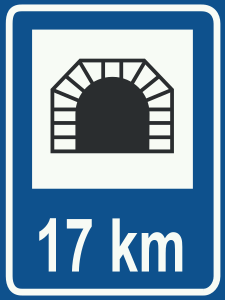
On bridges and viaducts you can suffer from side wind, especially outside the built-up area on high bridges and above large open water — a sign with a wind sock (J31) can announce this (Book p.97). Those same locations become slippery faster than ordinary roads in frost, because the wind also passes underneath and cools the road surface faster. The bridge light itself has one simple rule: if the red light is burning OR flashing, you stop, switch off the engine, and wait until the light is extinguished (Book p.97) — the state of the light (steady or flashing) makes no difference to your behaviour. At a tunnel, three signs inform you in advance: L13 shows the tunnel length, but only for tunnels longer than 250 metres; C22 with a letter indicates which dangerous substances may not pass through; K14 then points out the diversion route for those substances (Book p.98). Right before the tunnel you switch on your dipped headlights — well in advance, not only inside the tunnel, otherwise drivers behind you think you are braking — and take off any sunglasses (Book p.99). In case of breakdown in a tunnel you first try to get out of it; if that fails, you park as far right as possible, switch on the hazard lights, and walk — never crossing the carriageway — along the tunnel wall in the direction of traffic to the nearest emergency post (Book p.99-100). In case of fire in your own vehicle you park as close as possible to the wall, switch on the hazard lights, never turn around and never reverse, leave the key in the ignition, and leave the tunnel on foot via the nearest emergency exit (Book p.100).
Read this section on its own page: Core: Bridge and tunnel: side wind, the bridge light, and the tunnel emergency procedures
Why it matters
A sudden gust on a high bridge like the Zeelandbrug can push a light car sideways by tens of centimetres — exactly enough to hit a neighbouring lane. In a tunnel there is no verge to swerve onto and no room for a U-turn; someone who reverses against a queue or crosses there risks being hit by traffic that does not see them coming. The sequence 'along the wall, in the direction of traffic, never crossing' does not exist as a bureaucratic rule but because it is literally the only route on which you stay visible to the traffic behind you.
Read this section on its own page: Why it matters: Bridge and tunnel: side wind, the bridge light, and the tunnel emergency procedures
Source: RVV 1990 art. 32 · RVV 1990 art. 78 · checked 2026-10-22
Frequently asked questions
‘At the bridge light you only need to stop if the red light is flashing, not if it is burning continuously (steady) red’ – is that true?
No. 'if that burns or starts flashing, you stop'. Steady red and flashing red both mean the same thing at the bridge light: stop
‘Bridges and viaducts only become slippery in frost at the same moment as the rest of the road, not earlier’ – is that true?
No. Because the wind also passes underneath, a bridge's road surface cools faster and freezes earlier than ordinary roads
‘You may only switch on your dipped headlights once you actually enter the tunnel, not earlier’ – is that true?
No. Dipped headlights must go on well before you enter the tunnel, precisely because drivers behind you might otherwise think you are braking if the light only comes on inside the tunnel
‘In case of breakdown in a tunnel you may cross the carriageway if the nearest emergency post is on the other side’ – is that true?
No. You never cross the carriageway; you walk along the tunnel wall in the direction of traffic to the nearest emergency post on your own side
‘If your own car catches fire in a tunnel, your best option is to turn around or reverse to the nearest tunnel entrance’ – is that true?
No. You never turn around and never reverse; you park close against the tunnel wall, leave the vehicle, and walk away from the fire via the nearest emergency exit