Theory Mastery

Maximum speeds per road type: the five-rung ladder

What the exam asks here: Most candidates know exactly one number well: 50 km/u in the built-up area.

14 minutes · 7 sections · 12 questions

The trap

Many learners think: Outside the built-up area 80 km/u always applies, even on an autoweg.

The rule is: Km/u applies on ORDINARY roads outside the built-up area. An autoweg is a separate road type with its own signage and its own maximum of 100 km/u

Challenge

Most candidates know exactly one number well: 50 km/u in the built-up area. As soon as the CBR question brings in a woonerf, a 30 km-zone, or an autoweg, they paste that same 50 onto it — or 80, 'because outside the built-up area it's always 80, right?'. The book does not have two numbers, it has five, each tied to its own road type.

Read this section on its own page: Challenge: Maximum speeds per road type: the five-rung ladder

The model

The ladder (Book p.117-118): woonerf 15 · 30 km-zone 30 · built-up area 50 · outside the built-up area (ordinary roads) 80 · autoweg 100. The autosnelweg sits above it at a standard 130 — see the sister atom maxima.daglimiet_100 for that number's day/night nuance.

Read this section on its own page: The model: Maximum speeds per road type: the five-rung ladder

Core

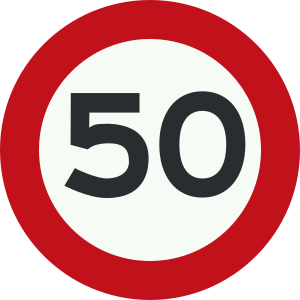
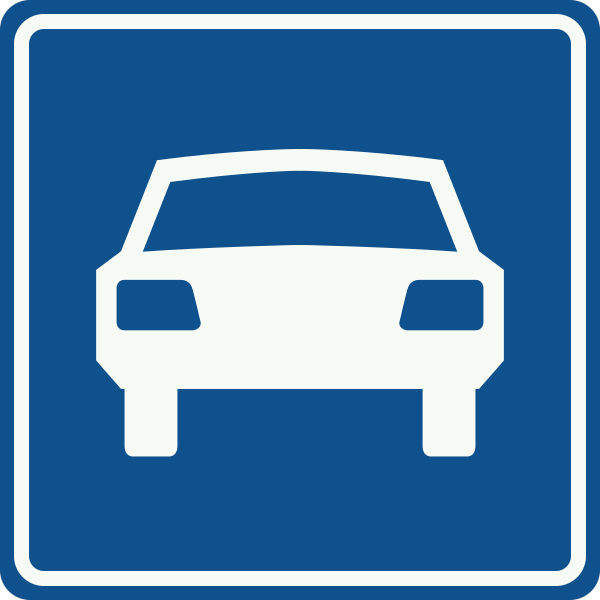
Woonerf (15 km/u) and 30 km-zone (30 km/u) are special road sections WITHIN the built-up area — they locally replace the ordinary 50 there. Within the built-up area, 50 km/u is the default, unless a sign locally indicates otherwise — the 30-zone and the woonerf are exactly such sign-based exceptions, not a separate legal category next to the built-up area. Outside the built-up area, on an ordinary road such as the N225, it is 80 km/u — that figure does NOT apply on an autoweg. On an autoweg outside the built-up area it is 100 km/u — a separate road type with its own signage (blue sign, car silhouette), not simply 'a faster ordinary road'. The autosnelweg sits above this ladder with a standard of 130 km/u; the commonly heard '100 on the motorway' is not a separate road type here, but the time-bound daytime reduction covered in maxima.daglimiet_100 — do not confuse the two.

Read this section on its own page: Core: Maximum speeds per road type: the five-rung ladder

Why it matters

The ladder is not an abstract distinction. On the Lindelaan in Wijk bij Duurstede, children play at street level — 50 km/u there is already dangerous, let alone 80. On the N225 outside Bunnik, other traffic does not expect you to suddenly drive 100 as if on an autoweg. Whoever mixes up the five rungs drives too fast or too slow at the wrong moment — both are exam errors and both are dangerous.

Read this section on its own page: Why it matters: Maximum speeds per road type: the five-rung ladder

Active recall

You leave Wijk bij Duurstede via a 30 km-zone near a primary school, then exit the built-up area onto the N225, and further on you see a blue sign with a car silhouette. What speed applies on that last stretch?

Read this section on its own page: Active recall: Maximum speeds per road type: the five-rung ladder

Teach back

Explain the five-rung ladder from low to high, and name one sign-based exception that deviates from the ordinary 50 km/u within the built-up area.

Read this section on its own page: Teach back: Maximum speeds per road type: the five-rung ladder

Memory hook

Woonerf 15 · 30-zone 30 · Built-up area 50 · Outside built-up area 80 · Autoweg 100. Autosnelweg standard 130 — day/night nuance: see maxima.daglimiet_100.

Read this section on its own page: Memory hook: Maximum speeds per road type: the five-rung ladder

Source: RVV 1990 art. 20 · RVV 1990 art. 21 · checked 2026-10-22

The picture

Five-rung ladder of maximum speeds per road typeRoad typeMaximum speedWoonerfwithin built-up area15 km/u30 km-zonewithin built-up area30 km/uBuilt-up area (default)unless a sign says otherwise50 km/uOutside built-up area, ordinary roade.g. N22580 km/uAutowegblue sign, car silhouette100 km/uAutosnelweg (standard)day/night nuance elsewhere130 km/u
What to look at: Woonerf 15, 30-zone 30, built-up area 50, outside built-up area 80, autoweg 100, autosnelweg standard 130 (see other atom).

Signs and law

Test yourself

You drive through the centre of Wijk bij Duurstede, turn onto the Lindelaan — a woonerf, no kerb, children playing — and two minutes later you are back on the N225, outside the built-up area. What maximum speed applies on each of these three stretches?

Show the answer

The ladder (Book p.117-118): woonerf 15 · 30 km-zone 30 · built-up area 50 · outside the built-up area (ordinary roads) 80 · autoweg 100. The autosnelweg sits above it at a standard 130 — see the sister atom maxima.daglimiet_100 for that number's day/night nuance.

Exam questions on this topic

About Maximum speeds per road type: the five-rung ladder: which statement is WRONG?

  1. The text itself explicitly says 'unless signs indicate a different maximum'.
  2. The woonerf has its own, lower maximum of 15 km/u; the 30 km-zone a separate maximum of 30 km/u.
  3. Km/u applies on ORDINARY roads outside the built-up area.
  4. The standard maximum speed on the autosnelweg is 100 km/u.
Show the answer

Correct answer: The standard maximum speed on the autosnelweg is 100 km/u.

The LEGAL standard speed on motorways is 130 km/u; 100 is the daytime reduction between 06:00 and 19:00. This atom only covers the non-motorway ladder; the day/night nuance lives in the sister atom

Why learners get this wrong: Within the built-up area exactly 50 km/u always applies; signs can never change that.

Open this question

The LEGAL standard speed on motorways is 130 km/u; 100 is the daytime reduction between 06:00 and 19:00.

  1. False
  2. True
Show the answer

Correct answer: True

The LEGAL standard speed on motorways is 130 km/u; 100 is the daytime reduction between 06:00 and 19:00. This atom only covers the non-motorway ladder; the day/night nuance lives in the sister atom

Why learners get this wrong: The standard maximum speed on the autosnelweg is 100 km/u.

Open this question

You leave Wijk bij Duurstede via a 30 km-zone near a primary school, then exit the built-up area onto the N225, and further on you see a blue sign with a car silhouette. What speed applies on that last stretch?

  1. 100 km/u — the blue sign with the car silhouette marks an autoweg
  2. 80 km/u — outside the built-up area it's always 80 anyway
  3. 30 km/u — the 30-zone near the school stays in force until the next built-up area
Show the answer

Correct answer: 100 km/u — the blue sign with the car silhouette marks an autoweg

The blue sign with the car silhouette marks an AUTOWEG: 100 applies there, not the ordinary 80 of an overige weg

Why learners get this wrong: Outside the built-up area 80 km/u always applies, even on an autoweg.

Open this question

Km/u applies on ORDINARY roads outside the built-up area.

  1. False
  2. True
Show the answer

Correct answer: True

Km/u applies on ORDINARY roads outside the built-up area. An autoweg is a separate road type with its own signage and its own maximum of 100 km/u

Why learners get this wrong: Outside the built-up area 80 km/u always applies, even on an autoweg.

Open this question

About Maximum speeds per road type: the five-rung ladder: which statements are correct? (multiple answers possible)

  1. Km/u applies on ORDINARY roads outside the built-up area.
  2. The LEGAL standard speed on motorways is 130 km/u; 100 is the daytime reduction between 06:00 and 19:00.
  3. A woonerf and a 30 km-zone are the same thing: both 30 km/u.
  4. After sign G4 (end of expressway) 60 km/h applies automatically until the next speed sign.
Show the answer

Correct answer: Km/u applies on ORDINARY roads outside the built-up area.; The LEGAL standard speed on motorways is 130 km/u; 100 is the daytime reduction between 06:00 and 19:00.

G4 only lifts the expressway regime; the road outside the built-up area is then an ordinary road: 80 km/h — 60 applies only with sign A1-60 / zone sign or on the recognisable 60 road without a centre line

Why learners get this wrong: A woonerf and a 30 km-zone are the same thing: both 30 km/u.

Open this question

You turn onto the Lindelaan in Wijk bij Duurstede — no kerb, street-level surface, children playing: a woonerf. What is the maximum speed (in km/u) on this road section?

Show the answer

Correct answer: 15 km/u

Correct: 15.0 km/u.

Open this question

You leave Bunnik via a short woonerf street and then exit the built-up area onto the N225 — an ordinary road, no separate road-type sign. What maximum speed applies on the N225?

  1. 80 km/u
  2. 30 km/u — you just drove through a woonerf, and that automatically becomes a 30-zone when leaving the built-up area
Show the answer

Correct answer: 80 km/u

Why learners get this wrong: A woonerf and a 30 km-zone are the same thing: both 30 km/u.

Open this question

You drive through Wijk bij Duurstede: first you pass a '30 km-zone' sign near a primary school, then — still within the built-up area — a street with no speed sign at all. What applies on that second stretch?

  1. 50 km/u — the ordinary built-up-area default applies as soon as there is no separate sign (anymore)
  2. 30 km/u — a 30-zone stays in force for the rest of the built-up area
  3. 30 km/u — once a sign-based exception applies anywhere in the built-up area, it stays in force for the rest of it
Show the answer

Correct answer: 50 km/u — the ordinary built-up-area default applies as soon as there is no separate sign (anymore)

Why learners get this wrong: A woonerf and a 30 km-zone are the same thing: both 30 km/u.

Open this question

Statement: within the built-up area exactly 50 km/u always applies — signs can never change that.

  1. True
  2. False
Show the answer

Correct answer: False

Why learners get this wrong: Within the built-up area exactly 50 km/u always applies; signs can never change that.

Open this question

You drive from a woonerf through a 30 km zone out of the built-up area. Then you drive on an ordinary road, on an autoweg and at 21:00 on the motorway. There are no extra speed signs. Which maximum speeds are right? (multiple answers possible)

  1. Woonerf 15 km/u and in the 30 km zone 30 km/u
  2. Motorway at 21:00: 100 km/u as the standard
  3. Autoweg 80 km/u, just like the ordinary road outside the built-up area
  4. Ordinary road outside the built-up area 80 km/u, autoweg 100 km/u
Show the answer

Correct answer: Woonerf 15 km/u and in the 30 km zone 30 km/u; Ordinary road outside the built-up area 80 km/u, autoweg 100 km/u

False — item: you take the daytime limit for the standard maximum. On the motorway the standard maximum is 130 km/u; 100 km/u applies in the daytime between 6:00 and 19:00.

Why learners get this wrong: The standard maximum speed on the autosnelweg is 100 km/u.

Open this question

All practice questions of this topic

Frequently asked questions

‘Outside the built-up area 80 km/u always applies, even on an autoweg’ – is that true?

No. Km/u applies on ORDINARY roads outside the built-up area. An autoweg is a separate road type with its own signage and its own maximum of 100 km/u

‘A woonerf and a 30 km-zone are the same thing: both 30 km/u’ – is that true?

No. The woonerf has its own, lower maximum of 15 km/u; the 30 km-zone a separate maximum of 30 km/u. Two different special road sections, two different numbers

‘Within the built-up area exactly 50 km/u always applies; signs can never change that’ – is that true?

No. The text itself explicitly says 'unless signs indicate a different maximum'. The 30 km-zone and the woonerf are exactly such sign-based exceptions within the built-up area

‘The standard maximum speed on the autosnelweg is 100 km/u’ – is that true?

No. The LEGAL standard speed on motorways is 130 km/u; 100 is the daytime reduction between 06:00 and 19:00. This atom only covers the non-motorway ladder; the day/night nuance lives in the sister atom

‘A green fill between the centre lines always means a 100 km/h road (expressway)’ – is that true?

No. Green + double BROKEN line = 80 road; green + double SOLID line = expressway 100 — the line type, not the colour, makes the difference; sign G3/G4 is decisive
Related topics

Open in the app